Comparisons
Zenoti Alternative for Wellness Centers: 7 Options
Compare each Zenoti alternative for wellness centers by workflows, pricing, integrations, migration, AI, and fit for appointment or class-based businesses.
 Watch · 20s
Zenoti is a serious platform for multi-location salons, spas, medspas, and wellness brands. That breadth is precisely why some operators choose it—and why others start looking for a Zenoti alternative. An independent recovery studio may not need enterprise-level complexity. A hybrid wellness center may need better class support. Another operator may care most about answering leads after hours rather than adding another reporting module.
This guide compares seven credible options by operating model, not by feature count. The goal is to help you build a defensible shortlist before scheduling demos.
How these alternatives were selected
This is an unranked shortlist, not a claim that one platform is best for every wellness center. Platforms were included when their published materials showed relevance to at least one common wellness model: appointment-led spas, class-based studios, hybrid centers, or multi-location operators.
The comparison considers:
- Appointment, class, resource, and staff scheduling
- Memberships, packages, payments, and point of sale
- Lead handling and client communication
- Multi-location administration
- Integrations and data access
- Migration support
- Public pricing availability
- Differences from Zenoti’s broader enterprise orientation
This review is based on vendor-published product, help, integration, migration, and pricing materials. It is not presented as hands-on product testing, a practitioner interview study, or an independent security audit. Vendor documentation establishes advertised capabilities, not how smoothly those capabilities will work in your business. Use the demo script later in this guide to verify them.
Pricing references are for the US market and were reviewed for this August 2026 comparison. Vendors can change plans, processing fees, included usage, and contract terms without notice. The linked pricing page—not this article—should be treated as the final source before purchase.
Seven Zenoti alternatives compared
| Platform | Scheduling focus | Automation or AI | Integrations | Multi-location | Published software pricing |
|---|---|---|---|---|---|
| WTF Go | Classes and wellness-business workflows | Fitty is marketed for lead response, booking, follow-up, and dues collection | Confirm required connections and data flows in a demo | Independent and multi-location operators | No verified public rate; request a quote |
| Mindbody | Classes plus appointments | Marketing and communication automation | Established integration ecosystem and API options; access may depend on plan or partner status | Strong fit for established and multi-site operators | Review current Mindbody pricing; final cost may require sales consultation |
| Vagaro | Appointments and classes | Messaging, forms, reminders, and marketing tools | Integrations and native business tools vary by function | Multiple-location support available | Calendar-based subscription with optional paid features; see Vagaro pricing |
| Boulevard | Appointment-led self-care businesses | Client messaging and workflow automation | Published integrations include business and marketing categories | Designed for growing self-care brands | Plan-based pricing; verify current amounts and add-ons on Boulevard pricing |
| Mangomint | Appointment-led salons and spas | Automated messages and workflow features | Published integrations plus API-related options on qualifying plans | Supports multiple locations | Public plans have historically been listed from $165 per month; verify current tiers at Mangomint pricing |
| WellnessLiving | Classes, appointments, and memberships | Marketing, reminders, rewards, and client communication | Native features and third-party connections vary by plan | Suitable for independent and multi-location businesses | Plan and add-on pricing should be confirmed through WellnessLiving pricing |
| Fresha | Appointment-led salons, spas, and wellness services | Client notifications and marketing tools | More controlled ecosystem than open-ended integration platforms | Supports teams and locations; validate headquarters reporting | Fresha has published subscription and usage-based charges; check current Fresha pricing for US rates and marketplace fees |
Only Mangomint’s starting figure is included because it has been publicly presented by the vendor and can be checked through the linked page. Exact figures are deliberately omitted where current US pricing, add-ons, or required sales configuration could not be stated confidently. A comparison is not more useful when it fills uncertain cells with stale numbers.
1. WTF Go: Best considered for front-desk automation
WTF Go is positioned as an operating system for gyms, studios, spas, and wellness businesses. Its defining component is Fitty, an AI receptionist and agent. According to WTF Go’s first-party product information, Fitty answers leads, books classes, follows up, and collects dues 24/7.
That makes WTF Go directly relevant when the reason for leaving Zenoti is operational: unanswered inquiries, inconsistent follow-up, or employees spending too much time chasing routine transactions. Zenoti is broader enterprise spa software; WTF Go’s differentiation is the AI-agent layer and its focus across fitness and wellness operations.
There are important questions to verify. WTF Go’s public claim establishes the intended workflows, but it does not by itself establish which phone, SMS, email, web-chat, or social channels are included in every plan. It also does not establish compatibility with every existing booking or payment system. Ask for a live demonstration of channel coverage, write-back behavior, consent handling, failed-payment workflows, and human escalation. Clinical charting and specialized medspa inventory should also be validated.
See how Fitty handles a wellness inquiry from first response through booking →
2. Mindbody: Broad ecosystem for classes and appointments
Mindbody is a logical Zenoti alternative for wellness centers combining group classes, private services, memberships, and consumer discovery. Its established marketplace and broad business-management stack are meaningful strengths for businesses that want booking, payments, marketing, and reporting under one vendor.
Compared with Zenoti, Mindbody generally has stronger recognition in boutique fitness and class-led wellness. Zenoti is more closely associated with enterprise salon, spa, and medspa operations. Neither should be assumed to be simple: package selection, add-ons, staff training, and configuration can materially affect the experience.
Mindbody publishes an integrations marketplace and developer resources, but operators should verify whether a specific integration is native, partner-built, or requires additional fees. Ask migration staff specifically about memberships, future bookings, package balances, waivers, and stored payment credentials.
3. Vagaro: Flexible for mixed service businesses
Vagaro serves salons, spas, fitness businesses, and other appointment-based operators. It supports appointments, classes, memberships, packages, forms, point of sale, inventory, and marketing-related workflows. That makes it worth considering for a wellness center that does not fit neatly into either “spa” or “studio.”
Its main difference from Zenoti is market position. Vagaro is commonly evaluated by smaller and midsize operators seeking a broad toolset without beginning with an enterprise implementation. The tradeoff is that optional features, bookable calendars, messaging, hardware, and payment terms must be totaled carefully.
Review the vendor’s support documentation and integration options before assuming a workflow is included. Migration assistance may be available, but importable fields and historical records depend on source data. Require a written migration scope rather than relying on “we can move your data.”
4. Boulevard: Strong for appointment-led client experience
Boulevard is designed around salons, spas, medspas, and other self-care businesses. Its strengths include appointment scheduling, checkout, forms, client profiles, communication, and front-desk workflows. It is a closer functional Zenoti competitor for appointment-led businesses than for centers built primarily around recurring classes.
Boulevard differentiates itself through a polished client and staff experience. Its limitation is fit: a wellness center running dense class timetables, complex waitlists, or fitness-style memberships should require a live demonstration of those exact scenarios.
Boulevard publishes an integration directory. Confirm whether each required connection is included in your plan and whether data moves in both directions. Migration should be tested for appointments, client notes, forms, memberships, gift cards, and account credits—not just contact records.
5. Mangomint: Usability-focused spa and salon option
Mangomint focuses on salons, spas, and medspas, with scheduling, point of sale, forms, inventory, client management, and automated communication. Its interface and workflow emphasis make it attractive to appointment-led teams trying to reduce front-desk friction.
Compared with Zenoti, Mangomint is generally a more focused option rather than an equivalent enterprise suite. That may benefit an independent or smaller multi-location business, but operators with complicated headquarters controls, franchise requirements, or class-heavy programming need deeper validation.
Mangomint documents its integrations and offers onboarding and data-import information through its sales and support process. Ask which Zenoti records can be imported, what remains read-only in archived exports, and who validates balances before launch.
6. WellnessLiving: Relevant for hybrid wellness centers
WellnessLiving combines classes, appointments, memberships, client apps, marketing, rewards, and business reporting. It deserves attention from yoga, Pilates, recovery, and wellness centers that need both scheduled groups and one-to-one services.
Its direct advantage over Zenoti is not necessarily greater breadth. It is the platform’s orientation toward fitness and wellness membership workflows. Zenoti may remain stronger for a complex enterprise spa operation; WellnessLiving may align better with recurring classes and community-based memberships.
The breadth also creates implementation risk. Ask the vendor to demonstrate permissions, cross-location memberships, automated campaigns, reporting, and every required integration. Confirm migration ownership and reconciliation procedures through WellnessLiving’s business resources.
7. Fresha: Marketplace-led appointment option
Fresha provides scheduling, marketplace discovery, point of sale, inventory, client management, and marketing tools for salons, spas, and wellness providers. It can be appealing to appointment businesses that value consumer discovery and want an alternative commercial model.
Fresha differs substantially from Zenoti’s enterprise positioning. Its marketplace and usage-related economics require close review. Operators should model subscription charges, payment processing, messaging, and any new-client marketplace fees using their own booking mix.
Fresha’s ecosystem can be more controlled than platforms built around broad third-party integrations. Review its software features and confirm data-export, accounting, marketing, and migration requirements. Class-heavy or medically regulated operators should not assume fit without a detailed demo.
How to run a fair replacement demo
Give every vendor the same tasks:
- Answer a new client’s after-hours pricing question.
- Book an appointment requiring both a practitioner and a room.
- Add a client to a full class and process the waitlist.
- Sell a hybrid membership covering classes and services.
- Recover a failed membership payment.
- Escalate a sensitive question to a human and preserve the conversation.
- Compare two locations without exporting a spreadsheet.
- Export clients, transactions, bookings, notes, and balances.
For AI products, ask what happens when the agent is uncertain, the client asks a clinical question, or no appointment matches. Determine which channels it monitors, when a human is alerted, how quickly staff must respond, and whether conversations are retained in the client record.
If lead coverage is your main problem, request a Fitty walkthrough using your real booking and escalation scenarios →. Treat it like every other vendor demo: require the team to show the workflow rather than describe it.
Build the total-cost comparison
Request a written quote covering subscription charges, locations, staff calendars, payment processing, messaging, marketing, branded apps, hardware, onboarding, integrations, migration, support, contract length, and cancellation terms.
Then add internal operating cost. Estimate which manual tasks remain after implementation: answering inquiries, following up with leads, reconciling balances, rebuilding reports, and correcting migration errors. The best Zenoti alternative is the one that improves your specific revenue workflows without creating a new set of workarounds.
Frequently asked questions
What is the closest direct alternative to Zenoti for a wellness center?
Boulevard or Mangomint may be closer for appointment-led spas, while Mindbody or WellnessLiving may fit class-and-membership businesses better. The closest match depends on whether your operation is spa-led, class-led, hybrid, or enterprise multi-location.
Which Zenoti alternative has an AI receptionist?
WTF Go markets Fitty as an AI receptionist that answers leads, books classes, follows up, and collects dues. Confirm supported communication channels, system integrations, compliance controls, and human-escalation rules during a live demo.
How much does it cost to replace Zenoti?
Costs can include subscriptions, locations, staff calendars, payment processing, messaging, add-ons, migration, hardware, and training. Request an itemized quote and model it using your actual staff count, booking volume, and transaction mix.
Can client and membership data be migrated from Zenoti?
Often at least some data can be moved, but payment credentials, notes, forms, historical transactions, credits, and custom fields may have restrictions. Obtain a field-level migration scope and reconcile sample records before going live.
Is this list ranked?
No. It is an unranked shortlist based on documented relevance to common wellness-center workflows; each option serves a different operating model.
Keep reading
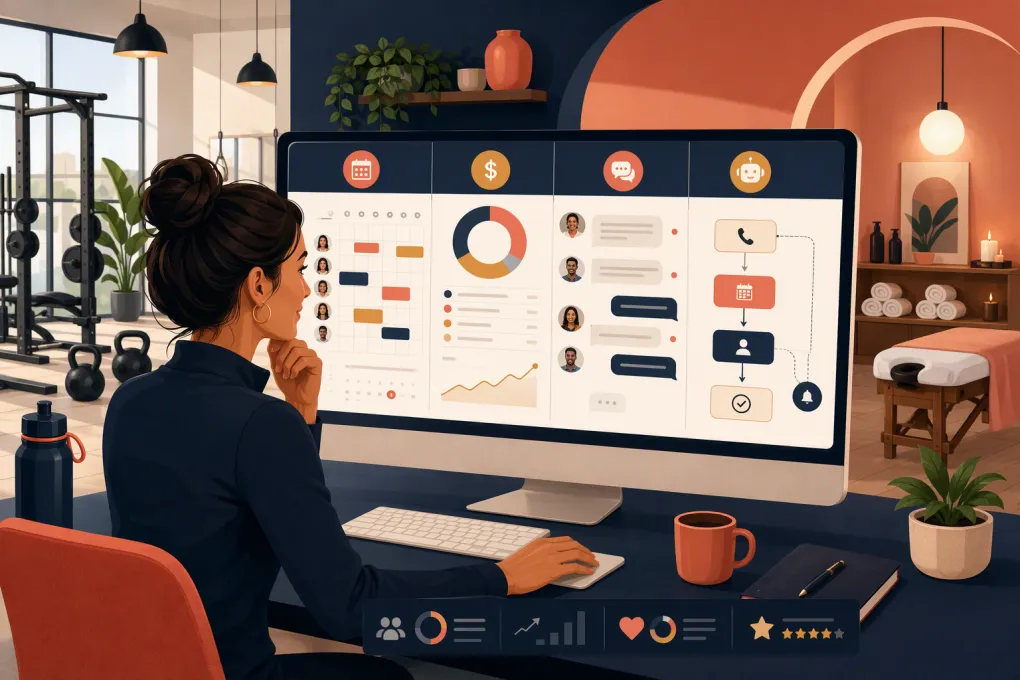


Run your gym on autopilot with WTF Go
Fitty — your AI receptionist — answers calls and DMs, fills classes, follows up with every lead, and collects dues while you coach.