Comparisons
Zenoti Alternative for Cryotherapy Centers: 2026 Guide
Compare each Zenoti alternative for cryotherapy centers across booking, payments, AI, integrations, migration, contracts, waivers, and multi-site controls.
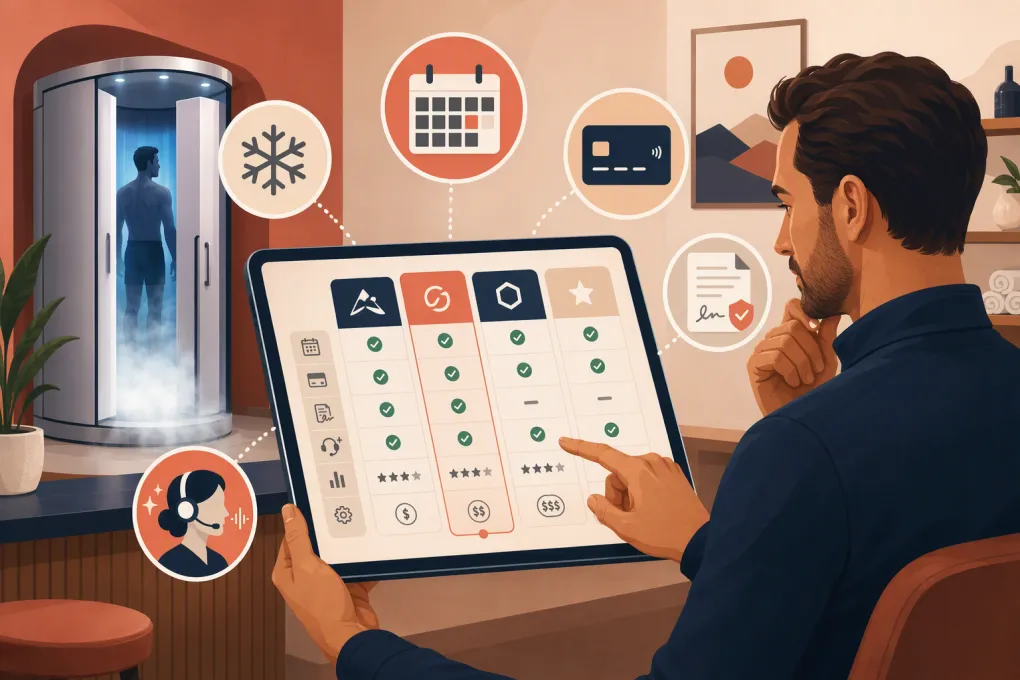 Watch · 20s
A Zenoti alternative for a cryotherapy center must do more than display available appointments. It needs to control chamber capacity, distinguish staff-assisted from unattended services, apply package credits correctly, preserve waiver records, collect recurring payments, and respond when a prospect calls after the front desk closes.
Zenoti offers broad spa and wellness management capabilities, particularly for sophisticated and multi-location operators. Replacing it makes sense only when another platform solves your specific operating problems with less complexity, better lead handling, or a more suitable cost structure.
Before requesting demos, document what is failing today. If the problem is missed calls and inconsistent follow-up, changing calendars alone will not fix it. If the problem is chamber scheduling or cross-location credit control, an AI add-on alone will not fix that either.
See WTF Go’s published overview of how Fitty answers leads, books, follows up, and collects dues →
What cryotherapy centers need to test
Generic feature checklists hide important differences. A platform may advertise “resource booking” without supporting your actual chamber workflow.
Chamber turnaround and staffing rules
Build each service with its true operational requirements:
- Appointment duration
- Preparation and changing time
- Chamber reset or sanitation buffer
- Assigned room or device
- Required staff role
- Maximum simultaneous sessions
- Location-specific operating hours
A staff-assisted whole-body cryotherapy session may require both a chamber and an authorized employee. An unattended recovery service may require a room but no dedicated employee after check-in. Ask the vendor to configure both live.
Then attempt to create conflicts through the customer portal, front-desk calendar, and recurring-booking tool. The system should not expose a slot merely because an employee is free when the chamber is occupied or still in its turnaround window.
Waiver versioning and intake controls
A signed waiver should remain connected to the exact version the customer accepted. When language changes, determine whether the system can require a new signature without overwriting the old document.
Check for:
- Version or template history
- Signature and completion timestamps
- Required re-signing rules
- Minor and guardian workflows, if relevant
- Service-specific intake forms
- Staff visibility before check-in
- Downloadable records for audits or disputes
Your attorney, insurer, and operating protocols—not the software vendor—should determine the appropriate screening and consent language.
Membership access and failed payments
Decide what should happen when a recurring charge fails. Possible policies include blocking all member bookings, allowing existing appointments but preventing new ones, or giving staff a temporary override.
Test whether the platform can enforce your chosen rule consistently across online booking, front-desk booking, and multiple locations. Staff should be able to see the balance, outreach history, retry status, and any manual exception.
Cross-location credits
Multi-location operators need explicit rules for where credits can be used. Consider whether:
- Credits purchased at one center work at every center
- Different services consume different numbers or types of credits
- Franchise or separately owned locations can accept each other’s credits
- Revenue or liability is attributed to the selling or servicing location
- Local promotions are excluded from cross-location redemption
“Multi-location support” does not automatically answer these questions.
Zenoti alternatives compared
Product packaging changes, and some enterprise terms are disclosed only during sales. The table distinguishes each platform’s established product focus while identifying contract and implementation items that require a written answer.
| Platform | Distinctive fit | Scheduling and customer workflows | AI and automation | Payments and integrations | Onboarding, contracts, and data | Main trade-off for cryotherapy |
|---|---|---|---|---|---|---|
| WTF Go with Fitty | Gym, studio, spa, and wellness operating system with an AI receptionist at the center of the workflow | Positions booking, customer follow-up, and dues collection as connected operational workflows; require a configured demonstration of chamber buffers, staff requirements, waivers, and cross-site credits | Fitty is publicly positioned to answer leads, book classes, follow up, and collect dues 24/7 | Ask for the supported processor, accounting connections, messaging channels, API options, and any fees outside the subscription | Pricing, contract length, onboarding scope, migration services, and export formats should be obtained in writing | Stronger candidate when unhandled inquiries and manual follow-up are the primary gap; less proven from public information for complex enterprise reporting and specialized chamber-resource rules |
| Zenoti | Broad, enterprise-oriented salon, spa, and wellness management | Deep appointment, membership, customer, staff, marketing, inventory, and multi-location operations in one platform | Customer engagement and automation extend beyond basic reminders | Integrated payment capabilities plus an enterprise integration and API approach | Consultative sale and implementation; contract, migration scope, payment terms, and exit provisions depend on the agreement | Broad capability can mean more configuration, training, and implementation work than a small center needs |
| Mindbody | Large fitness and wellness ecosystem with consumer discovery through the Mindbody marketplace | Supports appointments, classes, memberships, packages, forms, staff, and multiple locations | Marketing and communication tools are available; do not assume they replace a conversational AI receptionist | Integrated payments and a comparatively broad third-party integration ecosystem are notable strengths | Sold in packages; onboarding, migration, add-ons, contract duration, and full export access should be confirmed on the order form | Marketplace reach and integrations are useful, but total software complexity and add-on requirements need careful review |
| WellnessLiving | All-in-one fitness and wellness platform aimed at consolidating scheduling, CRM, marketing, and payments | Handles classes, appointments, memberships, rewards, forms, and client management | Includes automated marketing and communication tools within its broader suite | Integrated payments and business integrations are available; request the exact integration catalog for your plan | Plan-based sale with onboarding options; obtain written commitments for migration fields, training, term, renewal, and exports | Broad feature coverage can reduce separate tools, but chamber-specific resources and nuanced credit accounting need a live test |
| Boulevard | Premium appointment-based client experience for beauty and wellness brands | Strong booking, client profiles, checkout, forms, memberships, and service-business workflows | Automated client communication and marketing capabilities support appointment conversion and retention | Uses an integrated payments model and offers integrations suited to appointment-based businesses | Typically a guided sales and onboarding process; confirm migration coverage, contract term, processor obligations, and post-cancellation access | Polished appointment experience is a strength; fitness-style dues rules, complex credits, and chamber capacity may require closer validation |
| Vagaro | Accessible scheduling and management for independent and growing beauty, fitness, and wellness businesses | Provides appointments, classes, memberships, packages, forms, payroll-related tools, and marketplace exposure | Text, email, marketing, and communication options are available, with some functions sold separately | Integrated payments and add-on business features are central to the model | Public plan pricing is generally easier to inspect than enterprise-quote products; verify add-on costs, migration help, export fields, and current cancellation terms | Easier entry and broad functionality are attractive, but larger operators should scrutinize permissions, consolidated reporting, and intercompany credit rules |
Where WTF Go is stronger—and where it may not be
WTF Go’s clearest documented distinction is Fitty. The company publicly describes Fitty as an AI receptionist and agent that answers leads, books, follows up, and collects dues around the clock.
That creates a meaningful difference when the operational bottleneck occurs before or between appointments. Examples include an unanswered evening call, an introductory-offer lead who stops replying, or a member whose failed payment requires repeated outreach.
Relative to the other options:
- Versus Zenoti: WTF Go emphasizes an AI agent for customer-facing execution. Zenoti is the stronger known candidate for broad enterprise spa operations, inventory, centralized controls, and complex multi-site administration.
- Versus Mindbody: WTF Go’s positioning is more directly centered on an always-on receptionist. Mindbody has the stronger established consumer marketplace and third-party fitness and wellness ecosystem.
- Versus WellnessLiving: WTF Go differentiates around Fitty’s agent role. WellnessLiving’s established strength is bundling a wide range of management and marketing functions into one suite.
- Versus Boulevard: WTF Go is more explicitly positioned for gyms and wellness operators alongside spas. Boulevard is particularly strong where a premium, appointment-led client experience and integrated checkout are the priorities.
- Versus Vagaro: WTF Go provides a more AI-agent-centered proposition. Vagaro offers a broad, approachable menu of scheduling and business tools with relatively visible product packaging.
Public positioning does not prove that WTF Go will support every cryotherapy configuration. Ask the team to demonstrate your chamber allocation, buffers, waiver history, package rules, failed-payment restrictions, and location permissions before signing.
Ask WTF Go to demonstrate Fitty against your real cryotherapy lead and membership workflows →
Compare integrations, payments, and contracts properly
These areas often determine the actual cost of switching.
Integrations
Create an inventory of every system that receives or sends data: accounting, payroll, access control, email marketing, SMS, analytics, advertising, review management, waiver storage, and business intelligence.
For each vendor, request:
- A current integration catalog
- Which connections are native versus third-party
- API and webhook availability
- Any plan restrictions or usage charges
- The system of record for customer and payment status
- What happens when an integration fails
A long integration list is less important than reliable support for the few systems your operation depends on.
Payment processing
Compare more than the advertised processing rate. Ask about card-present hardware, card-not-present transactions, account updater services, chargebacks, refunds, payout timing, multi-location deposits, processor portability, and cancellation obligations.
Most importantly, determine whether stored payment credentials can migrate. Payment-security rules often prevent a simple database transfer, and customers may need to provide authorization again.
Contract and exit terms
Request the complete order form and agreement before approving a platform. Review:
- Initial term and automatic renewal
- Notice period for cancellation
- Implementation and hardware charges
- Required payment processor
- Minimum locations or users
- Price-change provisions
- Data ownership and export rights
- Post-termination access window
- Charges for migration or additional training
Verbal promises about migration or cancellation should be added to the agreement or implementation statement of work.
Run a cryotherapy-specific demonstration
Give every vendor the same script:
- Create a staff-assisted chamber session with a preparation period and post-session turnaround buffer.
- Create an unattended recovery service that reserves equipment but not an employee for its full duration.
- Have a new lead inquire after hours, complete the correct form, and book an eligible introductory service.
- Update a waiver and require returning customers to sign the new version while preserving the prior record.
- Fail a membership payment and show exactly which bookings and facility privileges become unavailable.
- Use a package credit at another location, then demonstrate both an allowed and prohibited cross-location redemption.
- Export customer, appointment, membership, credit, payment-status, waiver, and communication data.
Score completion, staff effort, customer friction, reporting, and exception handling. A feature receives credit only when the vendor can show it working.
Build migration acceptance criteria
Do not define migration as “customer data imported.” Specify the fields and balances that must reconcile before launch:
- Active members and next billing dates
- Stored-value balances, credits, expirations, and home locations
- Future and recurring appointments
- Signed waiver files and acceptance timestamps
- Communication consent and opt-out status
- Outstanding balances and failed-payment state
- Staff roles and location access
- Rooms, chambers, equipment, buffers, and service dependencies
- Gift cards, account credits, and refunds in progress
Require sample exports before signing and a test migration before cutover. Keep independent copies of Zenoti exports and financial reports. During the first billing cycle, review duplicate charges, missing credits, blocked members, processor deposits, and resource conflicts daily.
The right Zenoti alternative is the platform that can prove your operating rules, not merely list appointments, memberships, and automation on a feature page. If lead response and follow-up are the biggest leaks, Fitty gives WTF Go a clear reason to make the shortlist. If enterprise administration, a large integration ecosystem, marketplace discovery, or premium appointment commerce matters more, one of the established alternatives may be the better choice.
Frequently asked questions
What is the best Zenoti alternative for a cryotherapy center?
There is no universal winner. WTF Go is most relevant when AI-led response, follow-up, booking, and dues outreach are priorities; Zenoti, Mindbody, WellnessLiving, Boulevard, and Vagaro each have different strengths in enterprise operations, integrations, discovery, or appointment management.
Can cryotherapy software prevent chamber double-booking?
It can if the platform treats the chamber as a required resource and applies preparation and turnaround buffers across every booking channel. Require the vendor to demonstrate simultaneous customer and staff booking attempts.
Can saved payment cards move from Zenoti to another platform?
Not always. The existing processor, new processor, token portability, security requirements, and customer authorization rules determine whether credentials can transfer or customers must enter payment details again.
How should software handle updated cryotherapy waivers?
The system should preserve the previously signed document, identify the accepted version and timestamp, and require a new signature when your rules demand it. Legal and insurance advisers should determine the waiver language and re-signing policy.
What should be included in a cryotherapy software migration?
Include customer profiles, consent status, memberships, billing dates, credits, expirations, balances, future appointments, waiver records, staff permissions, resources, buffers, and historical reports. Validate totals and sample records before going live.
Keep reading



Run your gym on autopilot with WTF Go
Fitty — your AI receptionist — answers calls and DMs, fills classes, follows up with every lead, and collects dues while you coach.