Comparisons
TeamUp Alternative for Fitness Studios: 7 Options (2026)
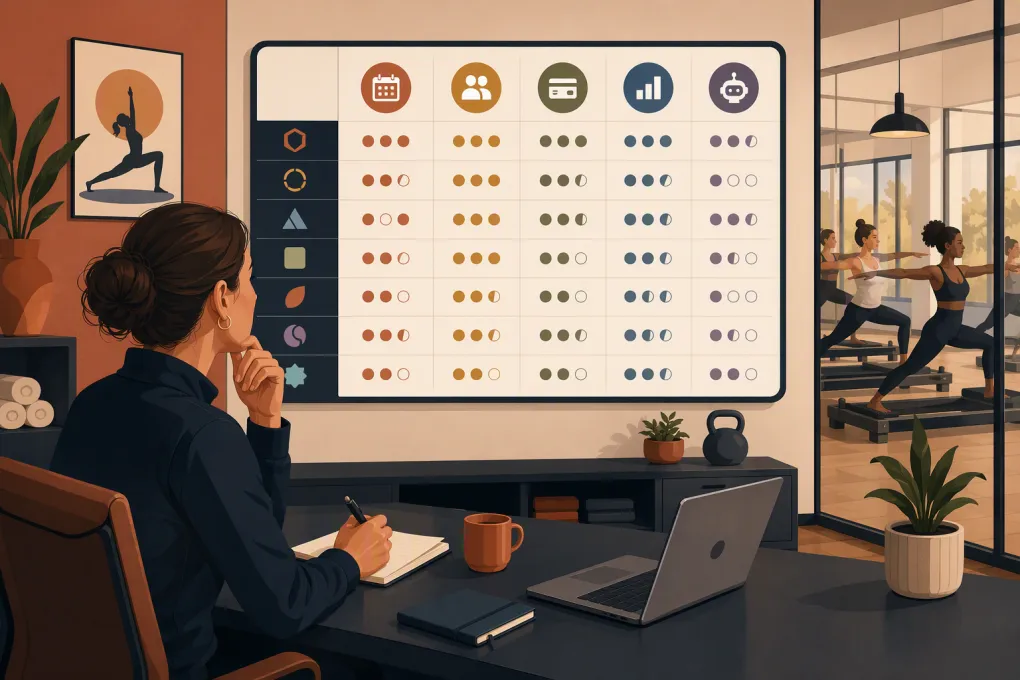
Compare each TeamUp alternative for fitness studios on booking, CRM, AI, reporting, integrations, support, pricing structure, and migration needs.
 Watch · 20s
TeamUp handles the fundamentals many class-based businesses need: scheduling, memberships, customer accounts, payments, forms, and communications. The reason to consider a TeamUp alternative is not that TeamUp cannot run a studio. It is that your operating model may now require deeper sales automation, appointment functionality, multi-location controls, a consumer marketplace, or an AI receptionist.
This guide compares seven credible options without pretending they are interchangeable. A Pilates studio selling recurring memberships has different requirements from a martial arts school, an appointment-heavy wellness business, or a multi-location gym.
Before replacing anything, name the workflow TeamUp is not handling well enough for your business. Otherwise, you may complete an expensive migration only to acquire a different version of the same limitations.
See how Fitty handles inquiries, bookings, follow-up, and dues workflows for studios →
How this comparison was researched
Transparency matters in software comparisons. This is an editorial assessment, not a controlled hands-on test or a paid mystery-shopping exercise. No customer reviews, invented test results, vendor rankings, or undocumented performance claims are used.
The comparison was assembled from publicly available vendor product, pricing, integration, support, and feature pages available at publication time. Primary sources include the official sites for TeamUp, WTF Go, Mindbody, ABC Glofox, WellnessLiving, PushPress, Zen Planner, and Vagaro.
We evaluated each platform against the same operator-level criteria:
- Class and appointment scheduling
- Membership and customer administration
- Lead management and follow-up
- Automation or AI capabilities
- Payments and overdue-account workflows
- Reporting and multi-location operations
- Integrations and data access
- Pricing transparency, contracts, onboarding, and support
Product packaging changes, and some capabilities depend on plan, region, payment processor, or configuration. There are no screenshots because this article does not claim authenticated access to every vendor account. Treat it as a documented shortlist, then require each vendor to demonstrate the same workflows using your requirements.
Why studios look beyond TeamUp
Based on TeamUp’s published feature set, its center of gravity is class-based business management: schedules, memberships, customer records, payments, forms, on-demand content, and related administration.
That can be exactly what a studio needs. The potential gaps appear when an operator wants functionality outside that core. Depending on the required workflow and plan, you may need to investigate:
- A sales pipeline with explicit stages, ownership, tasks, and lead attribution
- An AI agent that can conduct lead conversations and take defined actions
- Native appointment or resource workflows for treatment rooms and spa services
- Centralized multi-location reporting and cross-location customer rules
- A large consumer discovery marketplace
- More extensive marketing automation without connecting another platform
- Specialized gym, martial arts, or boutique-wellness workflows
These are evaluation points, not claims that TeamUp lacks every related feature. TeamUp publishes information about integrations and offers reporting and communication tools. The practical question is whether its implementation is deep enough for your process—or whether staff still bridge the gap with spreadsheets, inboxes, and manual calls.
TeamUp alternatives compared
| Platform | Scheduling and core operations | CRM, automation, and AI | Reporting, locations, and integrations | Commercial model and support | Strongest fit | Limitation to test |
|---|---|---|---|---|---|---|
| WTF Go | Fitness and wellness operating system covering lead-to-member workflows, including booking | Fitty is positioned as an AI receptionist that answers leads, books classes, follows up, and initiates dues follow-up | Intended for independent and multi-location operators; confirm required reports, payment setup, exports, API access, and named integrations | Contact WTF Go for current packaging, implementation, contract, and support terms | Studios trying to reduce manual front-desk and sales follow-up, not merely replace a calendar | Public documentation is less extensive than that of longer-established vendors; require a workflow demo and written scope |
| Mindbody | Broad class, appointment, staff, client, payment, and wellness-business functionality | Marketing and client-engagement products are available; package boundaries matter | Multi-location capability, business reporting, integrations, and a consumer marketplace are key parts of its ecosystem | Quote-led packaging; confirm required products, implementation, support tier, processing, and term | Established fitness and wellness businesses needing breadth and marketplace reach | Breadth can produce more configuration, training, and product complexity than a small class-only studio needs |
| ABC Glofox | Fitness-oriented class booking, memberships, payments, and branded member experiences | Lead-management and engagement capabilities are offered; verify the automation included in the proposed package | Positioned for independent gyms, studios, and larger fitness brands; integration and reporting requirements should be demonstrated | Generally quote-led; ask for an itemized proposal and support scope | Fitness brands prioritizing a polished branded app and growth across locations | Appointment-heavy spa workflows and unusual membership rules need explicit testing |
| WellnessLiving | Classes, appointments, client management, memberships, payments, and staff tools | Marketing, rewards, communications, and engagement tools are available across its product range | Broad wellness scope with reporting, integrations, and multi-location use cases | Packaged plans and optional products are published or quoted depending on configuration; verify contract and onboarding terms | Hybrid businesses combining classes, appointments, and wellness services | A broad toolset may require more setup than a focused class studio wants |
| PushPress | Gym-focused member management, class scheduling, billing, check-ins, and staff workflows | Lead and engagement functionality is available through its product suite; confirm which products are required | Designed around gyms and fitness businesses, with reporting and an integration ecosystem | Multiple product tiers and add-on products; review current public pricing and sales terms | Functional fitness gyms and owner-operated facilities wanting gym-specific workflows | Spa appointments, treatment resources, and broader wellness-marketplace needs are not its primary focus |
| Zen Planner | Membership management, scheduling, billing, attendance, and business websites for fitness businesses | Prospect and member communication tools are available; assess automation depth against a dedicated CRM | Reporting and integrations support established gym operations; verify consolidated multi-site requirements | Quote-led sales process; obtain written details for onboarding, processing, support, and contract length | Martial arts schools, boutique gyms, and membership-centered fitness businesses | Interface preferences, marketing workflow depth, and cross-location reporting should be tested directly |
| Vagaro | Strong appointment, calendar, marketplace, client, staff, and payment functionality, with class support | Marketing and communication tools are available; it is not primarily positioned as an autonomous fitness sales agent | Supports multi-location beauty, wellness, and fitness businesses and publishes an app marketplace | Publicly presented base packaging with optional features; confirm processing, messaging, hardware, and add-on costs | Spas and wellness businesses where appointments, providers, rooms, and services matter as much as classes | Membership-heavy gym workflows and complex class access rules may be less specialized than fitness-first systems |
No table can tell you whether a workflow is usable under pressure. It can show which vendors deserve a detailed demo.
A closer look at each option
WTF Go: for AI-assisted front-desk operations
WTF Go is the most relevant alternative when the problem extends beyond scheduling. Its differentiator is Fitty, an AI receptionist and agent.
The published product boundary is specific: Fitty answers leads, books classes, follows up, and helps collect dues around the clock. “Helps collect dues” should not be interpreted as debt collection, legal recovery, or independent movement of money. It means automated communication and action within the configured payment and account workflow. Likewise, booking is bounded by the schedules, availability, offers, and business rules made available to the system.
Fitty should not be assumed to resolve sensitive complaints, make medical recommendations, override policies, or invent discounts. During a demo, test escalation, conversation history, permissions, approved knowledge, opt-out handling, and what occurs when Fitty cannot answer confidently.
Ask WTF Go to demonstrate Fitty on your actual after-hours lead and failed-payment scenarios →
Mindbody: for ecosystem breadth
Mindbody spans fitness, beauty, and wellness, with class and appointment management plus consumer discovery through its marketplace. It belongs on the shortlist when marketplace exposure, provider scheduling, and a broad ecosystem outweigh the desire for a lightweight system.
Request a complete product map. Determine which CRM, marketing, branded-app, reporting, and messaging capabilities are included in the quoted package rather than assuming the full product portfolio is part of one subscription.
ABC Glofox: for a branded fitness experience
ABC Glofox focuses on gyms and studios and emphasizes branded member experiences, memberships, scheduling, payments, and growth tools. It is particularly relevant to fitness brands that want their digital experience to feel like their own operation.
Ask the vendor to show franchise or multi-location permissions, consolidated reporting, lead ownership, membership access across sites, and the exact process for exporting operational and customer data.
WellnessLiving: for mixed classes and appointments
WellnessLiving is worth considering when a business combines class schedules with appointments, staff calendars, rewards, and broader wellness services. Its breadth can reduce the need for separate point solutions.
The tradeoff is configuration. Verify which features are native to the proposed plan, which are optional, and how staff move between appointment, class, payment, and client-record workflows.
PushPress: for gym-centered simplicity
PushPress is designed specifically around fitness facilities, including member management, billing, check-ins, class operations, and gym growth products. Its domain focus makes it a logical TeamUp alternative for functional fitness and strength facilities.
Confirm whether the proposed configuration requires multiple PushPress products and how data, reporting, messaging, and permissions work across them.
Zen Planner: for established membership businesses
Zen Planner has long focused on membership-based fitness businesses, including martial arts and boutique gyms. Scheduling, attendance, billing, and member administration form its core.
Use the demo to examine prospect follow-up, mobile staff workflows, report customization, payment recovery, and the administrative steps required for freezes, family accounts, rank progression, or other specialized rules.
Vagaro: for appointment-led studios and spas
Vagaro deserves consideration when appointments, providers, rooms, and services are central. It supports classes as well, but its beauty-and-wellness orientation differentiates it from gym-first systems.
Test recurring fitness memberships, class credits, waitlists, and location access in detail. A platform can support both appointments and classes while still being materially stronger at one.
How to run a defensible software evaluation
Give every vendor the same script. Ask them to complete these tasks live:
- Capture an after-hours lead asking about price and beginner suitability.
- Book that person into an introductory class without staff intervention.
- Move the lead through defined pipeline stages and show the communication history.
- Fill a canceled class spot from a waitlist.
- Process a freeze, credit, location change, and cancellation request.
- Identify a failed recurring payment and show the complete follow-up sequence.
- Produce location-level and consolidated reports for sales, attendance, membership status, and revenue.
- Export customer, membership, booking, attendance, and communication data.
Then obtain written answers covering integrations, API or export access, support channels and hours, implementation ownership, data migration, training, payment processing, optional products, contract length, renewal, cancellation, and data return at termination.
Do not score a promised roadmap feature as if it exists. Do not accept “yes, we integrate” without seeing what records synchronize, in which direction, and how quickly.
Migration requirements to settle before signing
Ask each finalist to perform a sample migration using de-identified records. Include active, frozen, overdue, family, credit-bearing, and future-booked accounts.
Your written migration scope should address:
- Customers, prospects, notes, tags, and consent status
- Memberships, packs, credits, freezes, and expiration dates
- Future bookings and waitlists
- Attendance and transaction history
- Outstanding balances and failed-payment status
- Waivers and forms
- Staff roles and permissions
- Stored payment credentials
Stored cards may not transfer because of processor and security constraints. Establish the answer before selecting a launch date, not after member communication begins.
The best TeamUp alternative is the platform that fixes a documented constraint without introducing a worse one. TeamUp remains credible for class and membership administration. Mindbody offers ecosystem breadth; Glofox emphasizes branded fitness; WellnessLiving covers mixed wellness operations; PushPress and Zen Planner offer gym-specific depth; Vagaro is compelling for appointment-led businesses; and WTF Go is differentiated by Fitty’s defined AI receptionist workflows.
Frequently asked questions
What is the best TeamUp alternative for a class-based fitness studio?
The answer depends on the missing workflow. Compare WTF Go for AI-assisted reception, Glofox for branded fitness experiences, PushPress or Zen Planner for gym-specific operations, and Mindbody or WellnessLiving for broader wellness functionality.
Which TeamUp alternative is best for a spa that also offers classes?
Vagaro, Mindbody, and WellnessLiving merit consideration because appointments, providers, and wellness services are central to their product scope. Test recurring memberships and class access rules before choosing.
Does WTF Go replace TeamUp completely?
That depends on your required schedules, membership rules, payments, reports, and integrations. Ask WTF Go to demonstrate each current TeamUp workflow and document any migration or integration dependency.
Can stored payment cards migrate from TeamUp?
Not always. Credential portability depends on the payment processors, tokenization arrangements, security requirements, and vendor cooperation, so obtain written confirmation early.
How should I compare fitness studio software pricing?
Compare the full operating cost: subscription tiers, add-ons, processing, messaging, hardware, implementation, migration, support, contract terms, and the staff work needed to run connected systems.
Keep reading



Run your gym on autopilot with WTF Go
Fitty — your AI receptionist — answers calls and DMs, fills classes, follows up with every lead, and collects dues while you coach.