Comparisons
PushPress Alternative: 7 Gym Software Options Compared
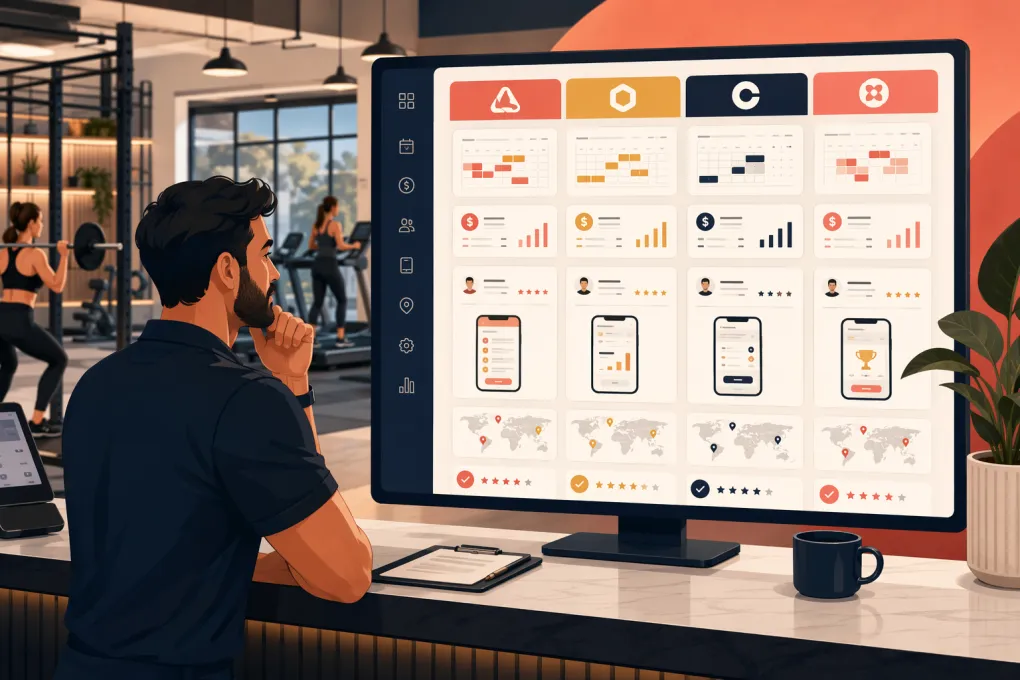
Compare every serious PushPress alternative by CRM, booking, payments, apps, migration, contracts, and switching tradeoffs for fitness business owners.
 Watch · 20s
PushPress is a credible operating platform for class-based gyms. It covers memberships, billing, scheduling, check-ins, and member management, while PushPress Grow adds lead nurturing and sales workflows. Switching only makes sense when another platform solves a specific operational problem better than that stack.
That problem might be appointment-heavy scheduling, martial arts progression, workout tracking, multi-location oversight, marketplace discovery, or after-hours lead handling. This guide compares those tradeoffs directly—including what you may lose by leaving PushPress.
PushPress alternatives at a glance
Exact prices are intentionally excluded because vendors change plans, usage allowances, processing terms, and required add-ons. Where commercial details are not standardized publicly, the table says so rather than presenting an unreliable number.
| Platform | CRM and booking structure | Payments and migration | App, commercial model, and best fit | Tradeoff versus PushPress |
|---|---|---|---|---|
| PushPress | Core gym operations are centered in PushPress Core. Sales CRM and automated lead follow-up are handled through the separate PushPress Grow product. Supports class-based scheduling and gym membership workflows. | Uses an integrated payments setup. Member data can be imported, but stored-payment transfer depends on processor and token-transfer eligibility. | Member-facing app available; custom branding depends on the selected package. Tiered subscription model, with total cost affected by products such as Grow and branded-app access. Best for class-based gyms wanting a gym-specific system. | Staying avoids retraining, member-app disruption, and billing migration. The main drawback is that a complete sales and operations stack may require multiple PushPress products rather than one workflow layer. |
| WTF Go | CRM, booking, billing, and marketing sit in one operating system. Fitty is an AI receptionist layer for lead conversations, class booking, follow-up, and configured dues-collection workflows. Supports gyms, studios, spas, and wellness businesses. | Payment setup and credential portability depend on the processor arrangement. Migration scope is established during onboarding rather than offered as a universal self-serve import. | Supports member and staff workflows across independent and multi-location businesses. Pricing, contract term, branded-app availability, and usage allowances are proposal-based rather than standardized publicly. Best for operators prioritizing automated front-desk coverage. | More suitable than PushPress when conversational lead handling is the central requirement. Less suitable when an operator wants public self-serve pricing, a mature sport-specific performance system, or a narrowly gym-only product. |
| Zen Planner | Membership management, classes, attendance, billing, and member progression are core strengths. Its martial arts features include rank and belt tracking. Lead and communication tools exist, but it is not primarily positioned as a conversational AI sales platform. | Integrated payment services are part of its broader business-management offering. Data conversion and onboarding are available, while payment-token movement remains processor-dependent. | Member app available. Packaging is generally handled through plans or sales consultation. Best for martial arts schools and other progression-based membership businesses. | Gains specialized rank and skill tracking that PushPress is not centered on. A general strength-and-conditioning gym may add complexity without gaining much operational value. |
| Wodify | Combines member management and scheduling with workout publishing, performance results, leaderboards, and functional-fitness workflows. Lead management is part of the business platform rather than a separate AI receptionist. | Provides integrated payment capabilities and onboarding resources. Historical workout data and payment credentials require special attention during migration because ordinary member imports may not preserve them cleanly. | Member mobile experience and branded-app options are available within its product structure. Pricing depends on selected products. Best for functional fitness gyms where performance data drives engagement. | Adds deeper workout tracking than PushPress. The tradeoff is paying for and administering performance features that yoga, Pilates, spa, or appointment-led businesses may not use. |
| Mindbody | Supports both classes and appointments, including staff and resource scheduling. Customer profiles are native; advanced lead management, marketing, messaging, and automation depend on package and add-on choices. | Uses its own integrated payments offering in supported markets. Structured onboarding and data-import assistance are available, but migration depth depends on the source data and purchased service. | Consumer booking through the Mindbody marketplace is a major differentiator. A custom branded app is an additional product rather than a universal inclusion. Contracts and pricing are sales-led. Best for studios, salons, spas, and wellness businesses seeking broad appointment support and discovery. | Gains stronger appointment infrastructure and marketplace exposure. Compared with PushPress, setup, packaging, and day-to-day administration can be heavier for a small class-only gym. |
| Glofox | Membership sales, lead management, class scheduling, payments, and member engagement are built around boutique fitness. Its CRM is part of the platform experience rather than a separate conventional gym database. | Integrated payment processing is supported. Onboarding and migration assistance are offered as part of implementation, with payment-token transfer governed by processor compatibility. | Branded member-app capability is a prominent offering. Commercial terms are quote-based and can vary by locations and selected services. Best for boutique studio brands emphasizing a polished digital experience. | Gains a brand-forward member journey and tools designed for boutique expansion. PushPress may remain simpler for an independent gym that does not need a highly customized app experience. |
| WellnessLiving | Supports classes, appointments, assets, memberships, client records, and marketing workflows. Lead capture and client communication are integrated into the broader platform, with some capabilities tied to package selection. | Integrated payments and migration assistance are available. Processor terms, hardware, and token portability must be addressed before contracting. | Client app is available; a custom branded app is sold as a separate product. Uses tiered packages, with additional products affecting total cost. Best for businesses mixing fitness classes, appointments, rooms, and wellness services. | Gains broader appointment and resource scheduling than a gym-first PushPress setup. The larger feature set can require more configuration and staff training. |
Where PushPress is strong—and where alternatives differ
PushPress is difficult to beat for straightforward gym operations
If the business primarily sells recurring memberships, runs classes, checks members in, and uses a familiar gym sales process, PushPress already covers the essential operating loop. Keeping it avoids several switching costs:
- Staff retraining and temporary productivity loss
- Member account activation in a different app
- New forms, waivers, automations, and website embeds
- Billing reconciliation across old and new systems
- Potential loss of historical attendance or communication detail
- Processor underwriting or payment-token complications
A dislike of one report or screen is rarely enough reason to accept those costs. First determine whether PushPress support, a configuration change, or adding Grow can solve the problem.
Choose around the workflow PushPress does not serve deeply enough
The alternatives become stronger when a requirement is central rather than occasional:
- AI-led receptionist coverage: WTF Go
- Martial arts rank and belt progression: Zen Planner
- Workout and performance tracking: Wodify
- Appointments plus consumer marketplace discovery: Mindbody
- Boutique brand and custom app experience: Glofox
- Mixed classes, appointments, rooms, and wellness services: WellnessLiving
These are not automatic reasons to switch. A CrossFit-style gym may value Wodify’s performance records, but moving years of workout history is more involved than importing contact records. A spa may gain better resource scheduling from Mindbody or WellnessLiving, but face a more extensive configuration process.
What Fitty’s 24/7 coverage actually means
WTF Go describes Fitty as an AI receptionist that can remain available outside staffed hours. That does not mean unrestricted authority over every conversation or financial action.
Its practical scope is the workflows the business connects and configures:
- Answering lead questions from approved business information
- Offering eligible classes, consultations, or intro options
- Booking against connected availability and business rules
- Following up through configured sequences or conversations
- Directing members into approved dues-payment or collection workflows
- Handing exceptions to staff when human review is required
“24/7” refers to the automated agent’s availability, not a promise that every issue will be resolved without staff. Fitty should not improvise cancellation policy, alter a contract, create an unapproved discount, or make an unsupported billing adjustment. Operators need to define escalation triggers, booking permissions, approved offers, collection language, and staff ownership of unresolved conversations.
That makes Fitty different from a conventional trigger-based CRM, which typically sends a predetermined message after an event. It does not make conventional automation obsolete. Fixed reminders remain appropriate for predictable events; conversational AI is more useful when a prospect asks questions or needs help reaching the next step.
Five decision-critical tests
1. Identify what is native, separate, or integrated
Ask the vendor to label every required function as:
- Included in the core subscription
- A separate first-party product
- A paid add-on
- A third-party integration
- A manual workaround
This exposes the real architecture. PushPress Grow, for example, should be evaluated as a connected product in the PushPress ecosystem—not treated as though every CRM function automatically belongs to Core.
2. Demonstrate the hardest booking
Use an actual edge case: a room and provider booked together, a cross-location membership, a parent paying for a dependent, or a private session deducted from a package. Appointment support should include duration, buffers, provider availability, resources, deposits, and cancellation rules—not merely a calendar labeled “appointments.”
3. Get payment constraints in writing
Document the required processor, card and ACH options, payout timing, refund permissions, chargeback handling, hardware requirements, and whether stored credentials can move. If tokens cannot transfer, members may need to enter payment details again, increasing launch risk.
4. Inspect the contract and total stack
Compare the full operating cost, including CRM, app branding, messaging usage, phone or AI usage, extra locations, onboarding, migration, hardware, integrations, and payment processing. Record the initial term, renewal process, cancellation notice, data-export rights, and any implementation fee.
5. Require a migration acceptance checklist
Define which records will move: active members, prospects, memberships, balances, credits, waivers, notes, future bookings, attendance, failed payments, and cancellation dates. Assign responsibility for deduplication and reconciliation. “Free migration” is not meaningful unless the included fields and validation work are specified.
A practical shortlist by operator type
A single-location class gym should begin by comparing the cost and disruption of leaving PushPress against simply adding or improving Grow. A martial arts school should test Zen Planner using real rank, family, and promotion workflows. A performance-driven functional fitness gym should test how Wodify preserves workout history and programming.
Appointment-led studios and spas should put Mindbody and WellnessLiving through resource-scheduling scenarios. Boutique brands should compare Glofox’s app experience with PushPress’s simpler gym-first operation. Businesses losing leads after hours should test WTF Go with real questions, booking exceptions, and escalation cases—not a polished canned conversation.
The right PushPress alternative is the one that removes a costly operational constraint without creating a worse billing, migration, or staff-adoption problem.
Frequently asked questions
What is the best PushPress alternative for a small gym?
If the gym mainly runs classes and memberships, staying with PushPress may be the least disruptive choice. Consider WTF Go for AI receptionist workflows, Wodify for performance tracking, or Zen Planner for martial arts progression.
Is CRM included with PushPress?
PushPress Core handles core gym management, while PushPress Grow is the separate first-party product focused on leads, sales pipelines, and automated follow-up. Compare the combined stack rather than evaluating Core alone.
Can stored payment cards move from PushPress to another platform?
Not automatically. Payment-token transfer depends on the current processor, destination processor, security requirements, and both vendors’ willingness to support the transfer.
Which PushPress competitor is better for appointments?
Mindbody and WellnessLiving are strong candidates for businesses combining classes with appointments, providers, and resources. Test deposits, buffers, room availability, package redemption, and cancellation rules before choosing.
Does Fitty replace front-desk staff?
Fitty can handle configured lead questions, booking, follow-up, and dues workflows outside staffed hours. Staff still need to own exceptions, sensitive account changes, policy disputes, and any action outside the permissions and information provided to the agent.
Keep reading



Run your gym on autopilot with WTF Go
Fitty — your AI receptionist — answers calls and DMs, fills classes, follows up with every lead, and collects dues while you coach.