Comparisons
The Practical Momence Alternative for Pole Dance Studios
Compare Momence alternatives for pole dance studios on booking, AI, pricing, payments, privacy, support, migration, reporting, and mobile apps to choose.
 Watch · 20s
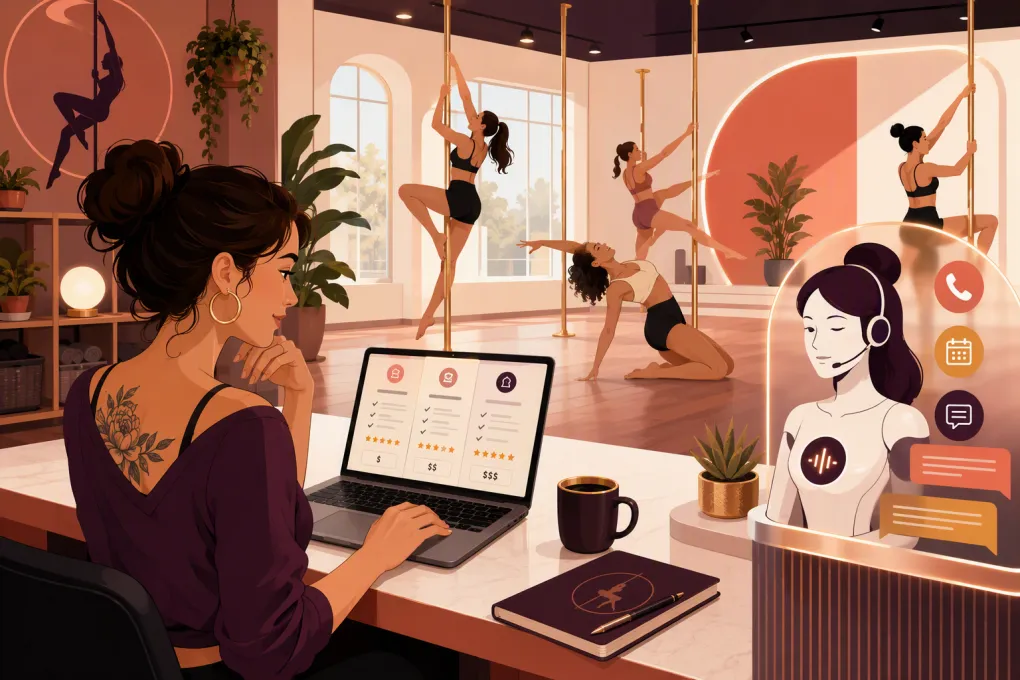
Pole dance studios create scheduling conditions that generic fitness software can handle only if it is configured carefully. Capacity may depend on the number of poles. Classes have experience levels and safety prerequisites. Revenue comes from memberships, class packs, workshops, private lessons, parties, and drop-ins—often with different booking rules.
Momence supports many of the standard workflows involved, including classes, appointments, memberships, payments, events, waitlists, and customer communication. That does not mean every pole studio should stay, nor does it mean switching will automatically improve operations.
A serious search for a Momence alternative for pole dance studios should answer two questions: What does another platform materially improve, and is that improvement worth migration risk?
See how WTF Go and Fitty handle inquiries, bookings, follow-up, and dues workflows →
How this comparison was evaluated
Transparency matters in software comparisons. WTF Go operates one of the products covered here, so this is not presented as an independent testing laboratory review. Our firsthand product knowledge applies to WTF Go and Fitty. Competitor information below is based on vendors’ publicly documented product and pricing pages, linked in the source notes.
We did not create matched production accounts, process live member payments, or conduct identical support tests across every competitor. Features, packages, and contract terms can also change. Accordingly, uncertain details are labeled for verification rather than presented as facts.
The comparison focuses on workflows that affect pole operators directly:
- Apparatus-based class capacity and waitlists
- Levels, prerequisites, waivers, and member notes
- Classes, privates, workshops, and recurring memberships
- Lead response and follow-up
- Failed-payment and dues workflows
- Reporting, integrations, mobile access, and support
- Privacy, permissions, migration, and commercial terms
Momence alternatives at a glance
| Platform | Operational strengths | Important limitations or checks | Best fit |
|---|---|---|---|
| WTF Go + Fitty | Combines business operations with an AI agent for configured lead responses, booking, follow-up, and dues outreach | Pole-specific capacity and progression rules must be configured and validated; AI requires an accurate knowledge base, booking access, guardrails, and human escalation | Studios primarily constrained by missed inquiries and repetitive front-desk work |
| Momence | Broad class, appointment, event, membership, payment, waitlist, and communication toolkit | Confirm whether current automations, reports, permissions, and package limits match your operation before replacing it | Class-led studios whose existing Momence setup already works reliably |
| Mindbody | Mature fitness and wellness ecosystem, consumer marketplace, classes, appointments, payments, reporting, and add-on business tools | Package complexity, add-on costs, implementation, and staff training deserve close review | Larger, multi-service, or multi-location operators that value ecosystem breadth |
| WellnessLiving | Scheduling, memberships, payments, marketing, rewards, reporting, and client-facing tools in one suite | Verify plan-specific functionality, integration depth, support access, and pole-level progression workflows | Studios seeking a broad all-in-one management suite |
| Vagaro | Strong appointment scheduling plus classes, payments, marketplace exposure, and optional business features | Class-heavy studios should test recurring schedules, waitlists, credit rules, and reporting; optional features can affect total cost | Studios mixing classes with privates, recovery, beauty, or other appointments |
These products all cover more than a basic calendar. The meaningful differences appear in workflow execution, packaging, and how much manual work remains after implementation.
A more concrete commercial comparison
Exact prices and processing rates should come from a written quote based on your locations, users, revenue model, hardware, and selected modules. Published entry prices rarely represent total operating cost.
| Criterion | WTF Go + Fitty | Momence | Mindbody | WellnessLiving | Vagaro |
|---|---|---|---|---|---|
| Pricing availability | Contact WTF Go for current scope and pricing | Official pricing page; plan inclusions should be checked | Pricing is commonly package- or quote-based | Official pricing information is available; confirm included features | Publishes plan information, with optional features affecting cost |
| Contract questions | Ask about term, onboarding, AI usage boundaries, and cancellation | Confirm term, cancellation, onboarding, and any minimum commitments | Confirm term, implementation obligations, renewal, and add-ons | Confirm term, onboarding, renewal, and cancellation | Confirm subscription terms and optional-feature commitments |
| Payment processing | Confirm supported processor, rates, hardware, payouts, disputes, and token-migration options | Review contracted rates, payout timing, hardware, and export or token options | Processing terms vary by agreement and region | Review processing and payout terms in the proposal | Payments are part of the platform offering; verify current rates and hardware costs |
| Integrations | Validate every required accounting, marketing, access-control, or analytics connection | Review current integrations and API availability for your plan | Broad ecosystem, but specific connections may require added products or fees | Offers integrations; verify whether each is native, third-party, or API-based | Offers an app marketplace and optional features; validate data flow in both directions |
| Reporting | Request demonstrations using your membership, attendance, lead, and collections questions | Includes business reporting; test exports and metric definitions | Broad reporting capabilities, with depth potentially tied to package | Includes reporting and analytics tools; test report customization | Includes business reporting; class-led studios should test membership and credit detail |
| Mobile experience | Test the current staff and customer workflows on the devices your studio uses | Offers customer-facing and business mobile workflows | Provides consumer and business mobile experiences | Provides client and staff-facing mobile options | Offers consumer and professional mobile apps |
| Support | Confirm channels, hours, implementation ownership, and escalation process | Confirm support channels and response expectations for your package | Support and onboarding experience can depend on package and implementation scope | Confirm included onboarding, support channels, and availability | Publishes support resources; verify live support coverage and onboarding scope |
Do not compare only subscription fees. Request an estimated first-year cost that includes onboarding, data migration, payment processing, branded apps, messaging, AI usage, integrations, access-control hardware, and early-termination obligations.
The pole-specific workflows every demo should prove
Generic feature lists are too shallow for this decision. Give each vendor the same demonstration script and require them to complete it in the product.
Capacity, waitlists, and levels
Ask the representative to create:
- An intro class limited to one student per pole.
- A shared-pole class with a different capacity.
- An advanced class with a clearly communicated prerequisite.
- A workshop excluded from normal membership credits.
- A full class with a waitlist and an automatic promotion process.
Most platforms can set class capacity. The harder question is whether they can enforce your different rules without staff maintaining side spreadsheets. Also confirm what happens when a room changes, a pole is unavailable, or an instructor substitutes into a class.
Products and payments
Test a recurring membership, a class pack with an expiration date, a private lesson, and a premium workshop. Then simulate a failed recurring payment and ask the vendor to show the member notification, staff task, retry process, account status, and reporting trail.
This is where Fitty can add operational value. It can participate in configured dues outreach and direct a member into an approved payment workflow. It should not be treated as an unrestricted debt collector or as a place for customers to dictate sensitive card details.
Ask WTF Go to demonstrate Fitty’s failed-payment and booking workflows with your studio rules →
What Fitty can—and cannot—do
Fitty is WTF Go’s AI receptionist and agent. When connected and configured for the appropriate workflow, it can answer routine lead questions, help book eligible classes, continue follow-up, and support dues collection processes outside staffed hours.
Those capabilities have boundaries:
- Answers depend on the policies, schedules, pricing, and approved content supplied by the business.
- Booking depends on available inventory, correct service mapping, and any prerequisites the system can enforce.
- Fitty should escalate injuries, medical concerns, charge disputes, unusual account issues, harassment, and exceptions requiring human judgment.
- It should not decide whether a student is physically ready for an advanced skill or override an instructor’s assessment.
- Payment conversations should route customers through approved, secure payment methods rather than solicit complete card details in ordinary chat or call transcripts.
- AI does not eliminate the need to review conversations, update policies, monitor errors, and assign staff ownership for escalations.
WTF Go also has tradeoffs. A studio must invest time in setup, policy documentation, escalation design, and testing. Operators seeking only a simple schedule may not need an AI agent. Studios with specialized door access, payroll, competition management, or deeply customized progression tracking must verify those requirements rather than assume they are native.
Privacy, waivers, transcripts, and access controls
Pole studios may hold signed waivers, injury notes, payment records, call recordings, transcripts, and private member communications. Do not place all of this information into a general notes field merely because the software allows it.
Ask every vendor—including WTF Go—for written answers to these questions:
- Which staff roles can view or edit waivers, member notes, billing data, recordings, and AI transcripts?
- Can permissions be limited by location or job function?
- Are administrative actions and record changes logged?
- What retention and deletion controls exist for calls and transcripts?
- Are customers informed when calls are recorded or handled by AI where required?
- Where is data stored, and which subprocessors receive it?
- How can a member request access, correction, or deletion where applicable?
- How are payment details kept out of ordinary messages and transcripts?
- What data can be exported when the studio leaves?
A waiver system is not automatically an appropriate medical-record system. Collect only information you genuinely need, restrict access, and obtain legal guidance for recording consent, privacy notices, retention, and health-related data obligations applicable to your business and state.
Migration and implementation risk
Before switching, obtain a field-by-field migration document. It should identify whether the new provider can import member profiles, active products, remaining credits, future bookings, waivers, notes, attendance history, account balances, and recurring payment credentials.
Payment tokens may not be portable between processors. If they cannot move, members may need to re-enter cards, which can interrupt recurring revenue.
Run these checks before launch:
- Compare several weeks of classes in both systems.
- Reconcile active memberships and remaining credits.
- Test instructor permissions and attendance from real devices.
- Verify waiver visibility and restricted notes.
- Complete test purchases, refunds, failed payments, and waitlist promotions.
- Confirm escalation ownership for Fitty or any automated messaging tool.
- Export a sample report and reconcile its totals to source transactions.
Which alternative should you choose?
Stay with Momence if it already handles your schedule, revenue products, reporting, communications, and staff workflows without costly workarounds. Migration is not an achievement by itself.
Choose Mindbody when marketplace reach and a broad fitness-and-wellness ecosystem justify its implementation and package complexity. Evaluate WellnessLiving when you want a wide management suite under one vendor. Consider Vagaro when appointments and mixed services are as important as group classes.
Evaluate WTF Go when the real gap is between having a booking system and consistently responding, following up, booking, and collecting. Fitty is most useful when your rules are documented, your schedule is accurate, and your team has a clear human escalation process.
The right decision should survive a scripted demonstration, a complete first-year cost comparison, a privacy review, and a migration rehearsal—not just a polished sales call.
Official source notes
Use these vendor-controlled pages to confirm current features and commercial terms before purchasing:
Vendor pages are primary sources for product availability, not independent evidence of usability or service quality. Request a recorded demonstration of your workflows and ensure all negotiated terms appear in the contract.
Frequently asked questions
What is the best Momence alternative for a pole dance studio?
There is no universal winner. WTF Go is worth evaluating for AI-assisted inquiries and follow-up, while Mindbody, WellnessLiving, and Vagaro may fit studios prioritizing ecosystem breadth, management features, or mixed appointment services.
Can pole studio software manage one-person and shared-pole capacities?
Most studio systems support class capacity, but flexible apparatus rules vary. Require a live demonstration of solo-pole, shared-pole, workshop, and reduced-capacity scenarios.
Can payment information be migrated from Momence?
Payment-token portability depends on the current and future processors and their security requirements. Obtain written confirmation before switching and prepare a card-update campaign if tokens cannot move.
Does an AI receptionist replace pole studio staff?
No. It can handle configured routine inquiries, booking, follow-up, and payment outreach, but safety questions, disputes, exceptions, and sensitive issues need human escalation.
What privacy questions should I ask a studio software vendor?
Ask about role-based access, transcript and recording retention, payment-data handling, audit logs, subprocessors, data exports, deletion procedures, and consent requirements.
Keep reading


Run your gym on autopilot with WTF Go
Fitty — your AI receptionist — answers calls and DMs, fills classes, follows up with every lead, and collects dues while you coach.