Comparisons
Best Mindbody Alternative for Strength & Conditioning Gyms
Compare each Mindbody alternative for strength and conditioning gyms by booking, CRM, AI, programming, pricing structure, migration risk, and operator fit.
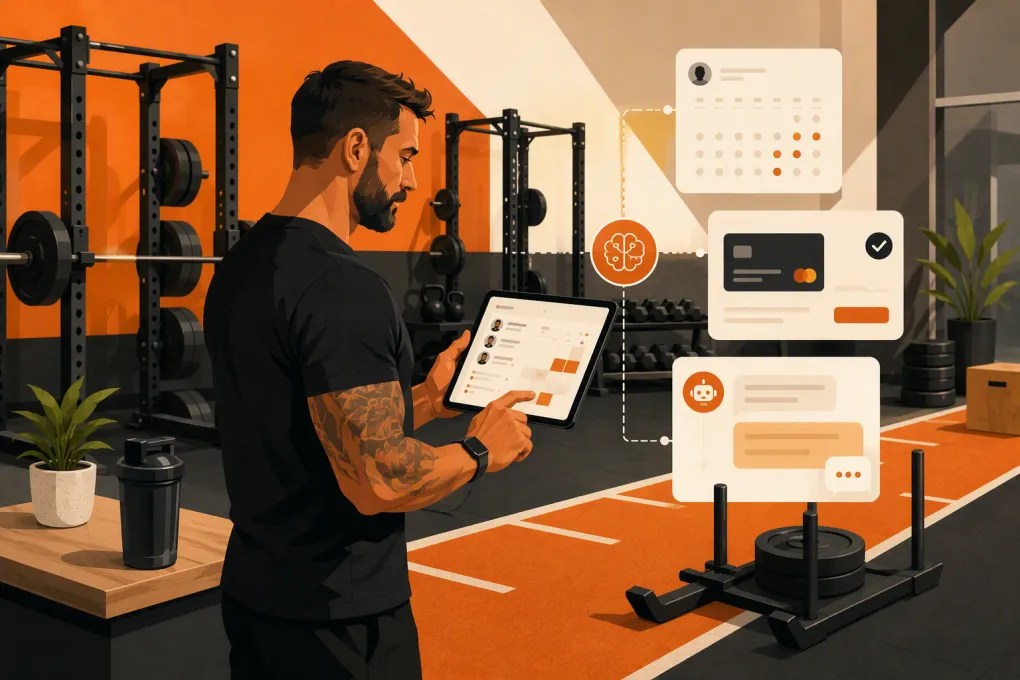 Watch · 20s
Mindbody can manage classes, appointments, memberships, and payments. The question is not whether it has features. It is whether its operating model fits a strength and conditioning gym selling assessments, capped group sessions, semi-private training, open gym access, youth programs, and recurring memberships.
Those workflows create different pressure points from an appointment-led spa. A coach cannot stop a session to answer every inquiry. A semi-private roster is not always managed like a standard class. Workout delivery may be essential—or completely separate from the business system. When operators look for a Mindbody alternative, they are usually trying to remove specific friction rather than replace one large feature list with another.
This comparison does not pretend every product was tested in an identical live gym or that a marketing screenshot proves operational fit. It uses publicly described product scope and concrete strength-gym workflows. Product packaging changes, so any capability that affects your decision should be demonstrated with your rules and included in writing.
If unanswered inquiries and inconsistent follow-up are driving the search, start with that workflow rather than rebuilding your entire stack blindly. See how Fitty handles lead response, booking, follow-up, and dues conversations →
Quick comparison: the strongest Mindbody alternatives
Pricing is intentionally described by structure rather than invented dollar amounts. Some vendors publish tiered pricing, while others use sales-led quotes or separate products. Processing, messaging, branded apps, onboarding, and add-ons can materially change the total.
| Platform | Scheduling and memberships | Sales and follow-up | Programming | Pricing structure and contract questions | Best fit | Main limitation to test |
|---|---|---|---|---|---|---|
| WTF Go | Positioned as an operating system for core gym workflows, including the records Fitty uses to book and follow up | Fitty is the native AI agent layer for answering leads, booking, follow-up, and dues outreach | Do not assume advanced workout design or athlete-performance tracking; scope this separately | Request a written quote showing platform access, payment processing, enabled AI channels, usage limits, onboarding, and contract terms | Operators whose main bottleneck is front-desk response and repetitive revenue administration | Confirm which operational modules are native, which processor is used, available reports, integrations, and human-escalation design |
| Mindbody | Mature class and appointment booking, memberships, waitlists, retail, and payments | Lead-management and marketing capabilities vary by package and setup | Not centered on strength programming or athlete result tracking | Generally sold through named feature tiers and a sales process; verify current tier inclusions, term length, processing, messaging, branded-app costs, and implementation | Mixed wellness businesses needing both classes and appointments or valuing Mindbody’s consumer marketplace | Breadth can create extra complexity for a coaching-led gym; test the exact lead and semi-private workflows |
| PushPress | PushPress Core is built around gym memberships, classes, check-ins, staff, and billing | PushPress Grow extends the stack into lead nurture and sales workflows | PushPress Train covers workout delivery and related coaching workflows | Modular structure means the relevant comparison may include Core plus Grow, Train, or other products; verify whether pricing is bundled and what requires a separate agreement | Functional fitness and strength gyms wanting gym-specific administration with optional adjacent products | Adding modules can reduce simplicity; verify shared records, reporting, messaging charges, and handoffs between products |
| Wodify | Gym administration includes scheduling, memberships, billing, attendance, and member-facing workflows | Business and engagement tools are available, but the exact nurture sequence should be demonstrated | Workout publishing, score entry, leaderboards, and performance history are key differentiators | Packaging is commonly quote-led or module-dependent; request one total covering management, performance, communications, processing, and onboarding | Gyms where daily programming and recorded athlete performance are central to the member experience | May provide more performance infrastructure than a gym needs; test sales automation and reporting separately |
| Zen Planner | Established scheduling, membership, attendance, and billing workflows for fitness and martial arts businesses | Member communication and engagement functions are available; test pipeline visibility and automated follow-up depth | Offers fitness-oriented tracking, but it should be compared against your exact programming method | Typically evaluated through a sales quote; confirm implementation, payments, communications, data conversion, and term conditions | Established membership businesses seeking conventional fitness-business administration | Interface fit and automation depth should be tested with staff, not inferred from a checklist |
| TeamUp | Focused class booking, recurring memberships, waitlists, access controls, and customer self-service | Provides automated communications and operational tools, but AI-led sales conversations are not its central proposition | Not primarily a strength-programming or athlete-performance platform | Pricing has generally been structured around customer volume; verify current bands, payment costs, messaging, migration, and cancellation terms | Independent gyms wanting relatively focused scheduling and membership administration | Operators may still need separate CRM, AI response, or programming systems |
The practical shortlist by operating model
The table becomes more useful when tied to the way the gym makes money.
Choose WTF Go when response capacity is the constraint
WTF Go is the most relevant option here when inquiries arrive while staff are coaching, follow-up is inconsistent, bookings require repetitive conversations, or overdue balances consume owner time. Fitty is designed to handle those conversations and actions rather than only logging a lead for staff.
That 24/7 availability needs qualification. It means the configured automation can operate outside staffed hours; it does not mean an employee is personally available at every moment. The actual channels—such as voice, text, web, or others—depend on the deployment agreed with WTF Go. During setup, define:
- Which inquiries Fitty may answer directly
- Which trial, class, or assessment it may book
- What schedule and capacity data it can access
- When it must stop and escalate
- Where the human receives the handoff
- What happens with medical, injury, refund, cancellation, or policy exceptions
- Which dues messages it may send and when staff approval is required
A useful implementation has boundaries. Fitty should own approved repetitive work, preserve the conversation history, and route exceptions to a person—not improvise on sensitive coaching, health, or account decisions.
Choose PushPress when you want a gym-specific modular stack
PushPress is easier to differentiate from Mindbody because its products are explicitly gym-oriented. Core covers business administration, Grow addresses lead management, and Train addresses programming. That separation can be an advantage if you want to buy only what the gym needs.
The operator question is whether those products behave like one system during a normal day. Ask the vendor to show a lead becoming a trial member, then a paid member, then appearing in the correct class and programming experience. Confirm whether staff must switch products, whether fields remain synchronized, and which reports span the full journey.
Choose Wodify when performance data is part of the product
For facilities where members expect to see workouts, record scores, track lifts, and compare historical performance, Wodify deserves a serious look. Its programming and performance orientation is a more concrete distinction than a generic claim about being built for gyms.
That depth matters less if coaches use another programming platform or do not publish workouts digitally. In that case, compare the sales pipeline, failed-payment workflow, staff usability, and total software footprint before paying for performance features.
Choose TeamUp when administrative simplicity matters most
TeamUp is a credible shortlist option for operators primarily needing schedules, memberships, waitlists, and customer self-service. It is less directly positioned around strength programming or an AI receptionist. That can be a strength for a gym wanting a narrower system, but it can also leave lead response and programming in separate tools.
Keep Mindbody when its breadth is useful
Replacing software is not automatically an improvement. Mindbody can remain the right choice for a business combining strength classes with massage, recovery services, appointments, retail, or broader wellness offerings. Its consumer marketplace may also matter to businesses that actively benefit from it.
The case for switching becomes stronger when staff regularly work around the platform, the gym pays for capabilities it does not use, or the missing workflow—often lead response or gym-specific programming—requires several additional systems.
What is native in WTF Go, and what must be scoped?
Calling software “all-in-one” without defining the system boundary is not useful. For this comparison, WTF Go should be evaluated in three layers.
Native agent workflow
Fitty is the native AI receptionist and agent. Its stated job is to answer leads, book classes, follow up, and assist with dues collection. The important distinction is that it is intended to take approved action, not merely summarize messages or create reminders.
Core operating records
Scheduling, member status, bookings, and payment status must be available to Fitty for those actions to work. Ask WTF Go to show where each record lives, who can edit it, and whether it is the system of record or synchronized from another system. Do not accept “integrated” as a complete answer.
Specialized and external functions
Advanced strength programming, velocity or wearable data, detailed athlete testing, accounting, payroll, access hardware, and specialized analytics may require separate products or integrations. Requirements vary by facility, and they should be documented during scoping rather than implied by the phrase “all-in-one.”
A strong WTF Go demo should show one uninterrupted workflow: inquiry received, approved questions answered, assessment booked against real capacity, reminders sent, staff handoff recorded, membership status updated, and dues follow-up triggered under the gym’s policy.
Run these five strength-gym tests in every demo
Generic demos hide the edge cases that create front-desk work. Give every finalist the same scenarios.
1. Semi-private capacity
Create a session with four athletes, one coach, recurring reservations, and different membership entitlements. Then move one athlete without losing the remaining reservations. Determine whether the platform treats this as a class, appointment, or workaround.
2. Assessment-to-membership conversion
Submit an after-hours inquiry from an inexperienced lifter. Ask whether the system can answer basic approved questions, book an assessment rather than an advanced class, notify the assigned coach, and continue follow-up after a no-show.
3. Youth athlete with an adult payer
Create separate athlete and guardian records. Test waivers, communication permissions, billing ownership, attendance, and schedule changes. Avoid systems that force staff to duplicate or overwrite contact details.
4. Open gym plus coached sessions
Give one member access to open gym and two coached sessions per week. Test booking restrictions, door-access implications, attendance, and what happens when the coached-session allowance is exhausted.
5. Failed payment during an active reservation
Fail a recurring payment for a member already booked into tomorrow’s class. See who is notified, whether booking or access rules change, how the member updates payment, and when a human takes over. This exposes the difference between processing payments and operating collections.
Compare the actual commercial terms
Request a one-page cost schedule from each finalist. It should identify:
- Base subscription and included locations
- Required sales, programming, or branded-app modules
- Payment-processing model and payout timing
- Messaging, phone, email, or AI usage charges
- Onboarding, training, and data-import fees
- Hardware or access-control costs
- Contract length, renewal, cancellation, and data-export terms
- Price changes tied to members, locations, staff, or usage
Do not compare Mindbody’s base tier with a competitor bundle that includes CRM and programming. Compare the complete configuration required to run your gym.
Treat migration as a field-level project
No responsible comparison should imply a painless migration without inspecting the source data. Strength gyms commonly encounter problems with recurring reservations, punch-card balances, family relationships, signed waivers, historical results, account credits, and payment credentials.
Before signing, obtain a field map showing whether each item will be imported, archived, rebuilt, or lost. Payment credentials require special handling and may not be portable between processors. Run test accounts for a semi-private member, youth athlete, open-gym member, frozen account, and overdue account before the final cutover.
Also preserve a read-only export of attendance, agreements, waivers, transactions, notes, and programming history. A successful migration is not merely seeing member names in the new platform; it is billing the right people, preserving future bookings, enforcing the correct entitlements, and giving coaches accurate rosters on launch day.
The bottom line
For programming-heavy facilities, start with Wodify and PushPress. For focused membership administration, include TeamUp. Keep Mindbody on the shortlist if appointments, marketplace exposure, or broader wellness services are material. Consider Zen Planner where its traditional fitness-business workflows match the operation.
Choose WTF Go when the expensive gap is the work between inquiry and booking—or between failed payment and resolution. Just insist on a scoped demonstration showing Fitty’s channels, permissions, escalation rules, system-of-record access, and human handoff.
See whether WTF Go can replace the lead and front-desk work your coaches handle manually →
Frequently asked questions
What is the best Mindbody alternative for a strength and conditioning gym?
Wodify and PushPress are strong candidates when programming is central, while TeamUp emphasizes focused administration. WTF Go is particularly relevant when lead response, booking follow-up, and dues outreach are the main operational bottlenecks.
Does WTF Go include workout programming?
Do not assume specialized workout design or athlete-performance tracking is included. Ask WTF Go to separate native operating and Fitty functions from any programming tools or integrations required for your coaching model.
Is Fitty available 24/7 without staff involvement?
Fitty can run configured workflows outside staffed hours, but operators should define approved channels, actions, escalation triggers, and human handoffs. Sensitive health, policy, refund, or account exceptions should be routed to staff.
How should I compare Mindbody alternative pricing?
Compare the complete required configuration, including CRM, programming, payment processing, messaging or AI usage, onboarding, hardware, locations, and contract terms. Base subscription prices rarely describe the full operating cost.
Can payment methods and workout history be migrated from Mindbody?
Possibly, but portability depends on the processors, export formats, and destination platform. Require a field-level migration map and test payment, booking, waiver, family, and performance records before cutover.
Keep reading



Run your gym on autopilot with WTF Go
Fitty — your AI receptionist — answers calls and DMs, fills classes, follows up with every lead, and collects dues while you coach.