Comparisons
Mindbody Alternative for Pickleball Clubs: What to Pick
Compare a Mindbody alternative for pickleball clubs across court booking, memberships, payments, CRM and AI, with a practical buyer's checklist for owners.
 Watch · 20s
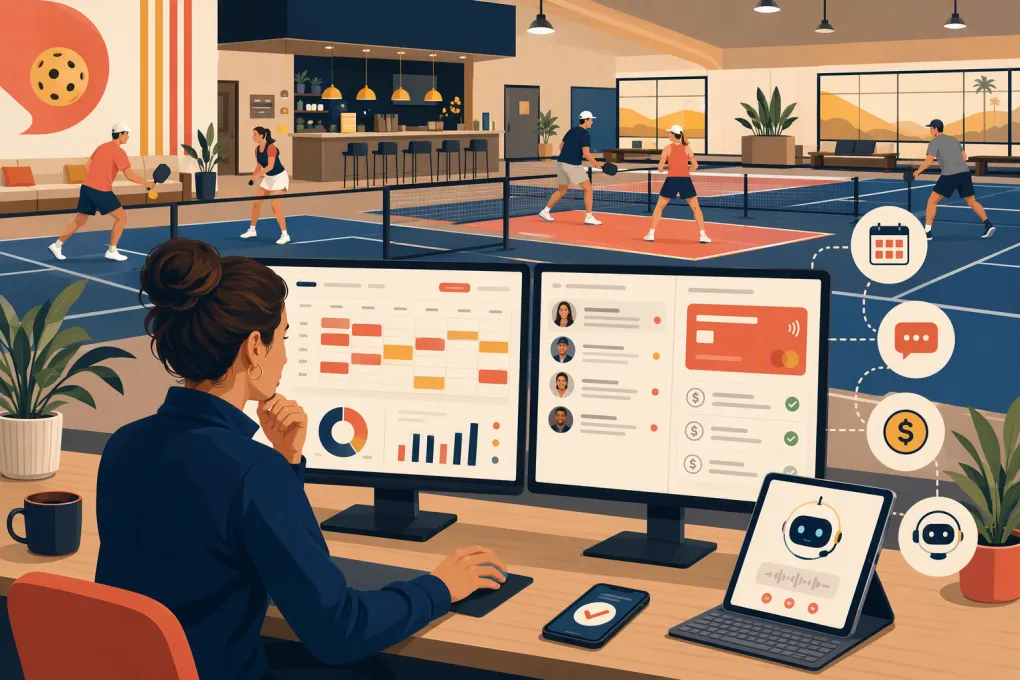
A Mindbody alternative for pickleball clubs should do more than put classes on a calendar. It needs to manage limited court inventory, organize open play and events, handle memberships, collect payments, and respond quickly when a prospective player asks a question.
That combination is where the decision gets complicated. Mindbody is widely used across fitness and wellness, but pickleball clubs often operate more like a hybrid of a sports facility, membership business, event venue, and pro shop. A platform built primarily around classes or appointments may require workarounds for court reservations, guest players, ladders, clinics, and recurring open play.
Before switching, identify the operational problem you actually need to solve. Specialized court software may be the right answer if reservation rules are your biggest concern. If missed calls, slow lead follow-up, fragmented member communication, and unpaid dues are costing you more, a broader operating system with AI automation may be the better fit.
See how Fitty handles pickleball inquiries, follow-up, booking, and dues around the clock →
Why pickleball clubs look beyond Mindbody
Mindbody can support common fitness-business workflows such as scheduling, client management, payments, and marketing. For a club offering clinics, lessons, and fitness programming, those capabilities can be useful.
The friction usually appears in workflows that are specific to racquet facilities:
- Reserving a particular court or court type
- Preventing conflicts across courts, lessons, leagues, and events
- Applying different advance-booking windows by membership tier
- Managing guests, drop-ins, and nonmember rates
- Creating open-play sessions with capacity limits
- Coordinating instructors, courts, and participants
- Handling waitlists and cancellations
- Selling memberships, clinics, merchandise, and events
- Answering repetitive questions outside staffed hours
No single platform is automatically best at all of these. The strongest choice depends on whether your club is court-led, program-led, or growth-led.
Mindbody alternatives for pickleball clubs compared
The table below focuses on operational fit rather than declaring one universal winner. Features, packaging, and integrations can change, so confirm critical workflows directly with each vendor before signing a contract.
| Platform | Court and program booking | CRM and communication | Automation or AI | Multi-location fit | Pricing approach | Best fit and limitations |
|---|---|---|---|---|---|---|
| WTF Go + Fitty | Supports booking-oriented fitness and wellness workflows; clubs should verify their exact court, resource, and recurring reservation requirements | Centralized lead and member operations, follow-up, and communication | Fitty answers leads, books eligible offerings, follows up, and helps collect dues 24/7 | Designed for independent and multi-location operators | Contact WTF Go for current packaging | Best for clubs prioritizing lead response, member communication, revenue follow-up, and consolidated operations. Confirm advanced court-allocation rules during evaluation. |
| CourtReserve | Purpose-built around court reservations, events, lessons, leagues, and racquet-club operations | Member management and club communication tools | Operational notifications and workflow automation; evaluate AI lead-conversation needs separately | Suitable for clubs with multiple courts and facilities; confirm organization-wide reporting needs | Vendor offers packaged plans; request current pricing and applicable add-ons | Strong fit when court inventory and racquet-specific programming drive the business. Clubs wanting a broader AI receptionist should assess complementary tools. |
| PodPlay | Built for modern racquet and recreational facilities, with booking and club-management workflows | Customer-facing booking and club engagement capabilities | Includes technology-led facility operations; confirm the scope of conversational AI and collections automation | Relevant to expanding pickleball concepts; validate controls required by your structure | Pricing is generally sales-led rather than a simple universal rate | Strong option for technology-forward pickleball venues. Evaluate payment, CRM, and integration details against your exact operating model. |
| Club Automation | Scheduling and facility-management capabilities for health clubs and larger recreation businesses | Membership sales, billing, CRM, and engagement functions | Provides business automation; confirm AI receptionist capabilities separately | Often considered by larger or more complex club organizations | Quote-based and dependent on business requirements | Broad operational depth for established facilities. It may be more system than a small, single-site club needs. |
| Upper Hand | Sports scheduling, facility rentals, lessons, camps, and event management | Customer, staff, and payment management for sports businesses | Workflow automation is available; evaluate conversational AI requirements separately | Can support growing sports organizations | Packaged or quote-based depending on current offering | Useful for clubs operating like sports facilities with coaching and events. Verify racquet-specific booking rules and membership functionality. |
| Mindbody | Strong class and appointment scheduling; court-specific resource rules may require validation or configuration | Established consumer profiles, marketing, and business-management tools | Offers automation and business tools, with capabilities varying by plan and product | Used by businesses ranging from individual locations to larger brands | Plan-based pricing, with some functions potentially tied to package level or add-ons | Familiar option for class- and wellness-led businesses. A court-heavy pickleball model may need more specialized workflows. |
Start with the court-booking rules
A polished booking page does not prove that a system can handle your reservation policy. Build a test script using situations your staff encounters every week.
Ask each vendor to demonstrate these scenarios live:
- A premium member books seven days ahead while a basic member has a shorter booking window.
- A player reserves a court and adds three guests with the correct fees.
- A private lesson requires one instructor and one specific court.
- An open-play session reaches capacity and starts a waitlist.
- A cancellation releases the court and notifies the next eligible player.
- A tournament blocks multiple courts without disrupting unrelated reservations.
- A member with an overdue balance attempts to make another booking.
- Staff move a reservation while preserving payments and notifications.
If the representative cannot demonstrate the workflow without vague promises or manual patches, treat that as a warning. Court conflicts are not minor administrative issues. They create front-desk work and a poor member experience.
Evaluate lead response separately from scheduling
Court software and sales follow-up software solve different problems. A platform may be excellent at displaying available courts while doing little when a new player calls after closing time and asks:
- Do you offer beginner lessons?
- Can nonmembers join open play?
- Do you rent paddles?
- Which membership should my family choose?
- Can I book a corporate event?
- Is there an indoor court available tomorrow?
Those conversations often happen before someone creates an account. If nobody responds until the next shift, the prospect may contact another club.
Fitty, WTF Go’s AI receptionist and agent, is designed to answer leads, support booking, continue follow-up, and collect dues 24/7. For a pickleball operator, that means fewer inquiries sitting in voicemail, inboxes, or disconnected staff phones. The important implementation step is to give the agent approved answers, escalation rules, current offerings, and clear boundaries around what it can book.
See how WTF Go can turn after-hours pickleball inquiries into trackable follow-up and bookings →
Check membership, payment, and guest workflows
Pickleball revenue is rarely limited to one product. A club may sell monthly memberships, court time, open play, clinics, private lessons, leagues, tournaments, guest passes, rentals, and retail products.
During a software demo, test how the system handles:
Membership rules
Confirm whether you can define booking privileges, discounts, household access, freezes, expiration dates, and usage limits. Ask what happens when a member upgrades or changes plans in the middle of a billing period.
Failed payments and outstanding dues
Find out how failed charges enter a follow-up workflow. The system should make the balance visible to staff and give members a clear way to resolve it. If collections depend entirely on employees remembering to call, the process will be inconsistent.
WTF Go makes this follow-up a practical part of the operating system: Fitty can help pursue outstanding dues instead of leaving every reminder to the front desk.
Explore an AI-assisted dues and member follow-up workflow for your club →
Guest and household accounts
Family memberships and guest play can expose weak account structures. Test whether each participant can sign required waivers, receive relevant notifications, and maintain an accurate visit history without creating confusing duplicate records.
Refunds, credits, and cancellations
Ask who can issue a refund, how account credits are tracked, and whether cancellation penalties can vary by offering. Review the resulting reports, not just the customer-facing screen.
Do not ignore the front-desk workload
Operators often compare member-facing features while overlooking the number of staff steps behind them. Count the clicks required to complete routine tasks:
- Add a walk-in to open play
- Move a lesson to another court
- Apply a guest fee
- Fix a duplicate profile
- Resend a payment link
- Pause a membership
- Identify an unanswered lead
- View tomorrow’s court utilization
Also check permissions. Coaches should not necessarily have access to billing records, exports, or organization-wide settings. Multi-location operators need controls that separate local work from company-level oversight.
A system is not easier merely because its interface looks modern. It is easier when common tasks are hard to get wrong.
Plan the migration before choosing a vendor
Migration risk should influence the purchase decision. Create an inventory of what must move:
- Active and frozen memberships
- Stored credits and unpaid balances
- Future reservations and recurring bookings
- Packages, passes, and expiration dates
- Signed waivers
- Family and household relationships
- Staff permissions and schedules
- Lead notes and communication history
- Payment tokens, where portable and permitted
- Financial and attendance records needed for reference
Ask the vendor which records it imports, which require manual setup, and which should remain in a read-only archive. Payment data deserves special attention because processors and security requirements can limit portability.
Run parallel checks before launch. Compare active-member counts, upcoming reservations, account credits, and outstanding balances between the old and new systems. Avoid switching immediately before a tournament, major league launch, or membership renewal cycle.
How to choose the right alternative
Use a weighted scorecard instead of choosing from a feature checklist. Assign the most weight to workflows that affect revenue and member experience every day.
A court-led club should prioritize reservation rules, waitlists, event blocks, and guest management. A program-led facility may care more about clinics, instructors, packages, and recurring sessions. A growth-led club should place more weight on lead capture, response speed, follow-up, sales visibility, and dues collection.
WTF Go is particularly relevant when the operational gap extends beyond court booking. If your staff is stitching together scheduling, phone calls, texts, lead notes, payment reminders, and member follow-up, consolidating those workflows can be more valuable than replacing one calendar with another.
The right Mindbody alternative is ultimately the platform that passes your real-world tests with the fewest workarounds. Document those tests, involve front-desk staff in the evaluation, and require vendors to show the difficult workflows—not just the attractive dashboard.
Frequently asked questions
What is the best Mindbody alternative for a pickleball club?
CourtReserve is worth evaluating for court-centric operations, while WTF Go is a strong candidate when AI lead response, follow-up, booking support, and dues collection are priorities. The best choice depends on your reservation rules and broader operating needs.
Does pickleball club software need dedicated court scheduling?
Usually, yes. Clubs should test resource conflicts, membership booking windows, guest fees, waitlists, lessons, open play, and multi-court event blocks before selecting a system.
Can WTF Go replace Mindbody for a pickleball club?
WTF Go can replace or consolidate key lead, member, booking, communication, and payment-follow-up workflows. Clubs with advanced court-allocation requirements should verify those specific scenarios with WTF Go before migrating.
What data should we export before leaving Mindbody?
Export member profiles, memberships, balances, credits, future bookings, packages, waivers, attendance records, staff data, and any financial records you need to retain. Confirm separately whether payment credentials can be transferred.
How should a multi-location pickleball operator compare platforms?
Test centralized reporting, location-level permissions, cross-location memberships, shared customer profiles, brand-level communication, and whether courts and staff can be managed without exposing every setting to every location.
Keep reading



Run your gym on autopilot with WTF Go
Fitty — your AI receptionist — answers calls and DMs, fills classes, follows up with every lead, and collects dues while you coach.