Comparisons
Mindbody Alternative for Med Spas: A Practical Guide
Compare each Mindbody alternative for med spas by clinical records, scheduling, AI follow-up, payments, pricing structure, and migration requirements.
 Watch · 20s
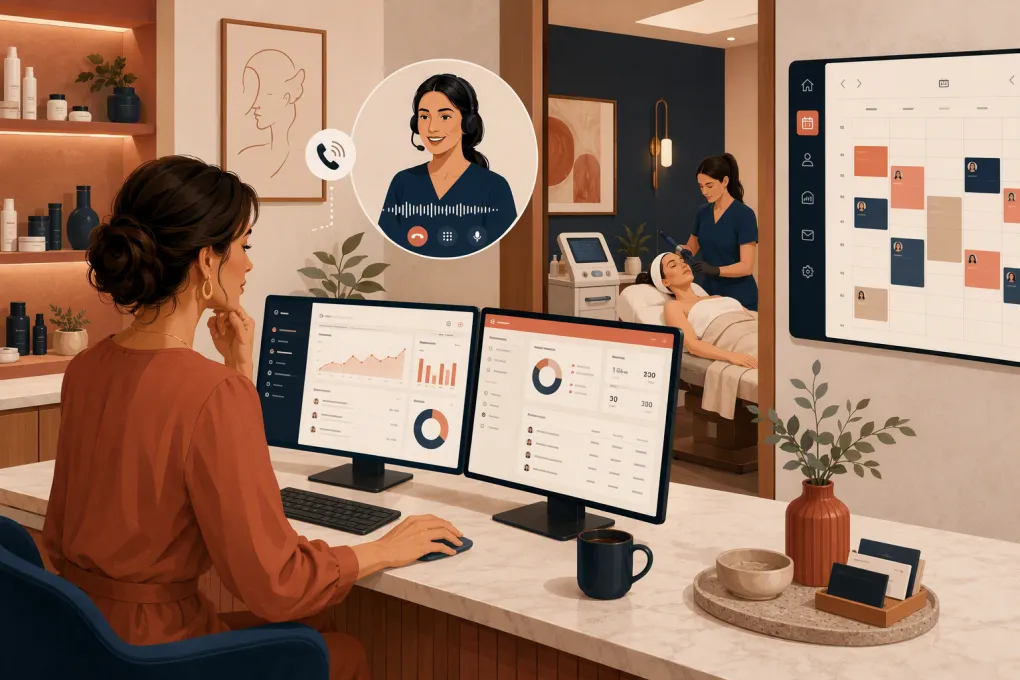
A med spa replacing Mindbody is rarely shopping for scheduling alone. The real decision is whether one platform can support both sides of the business: the commercial workflow that turns inquiries into booked treatments and the clinical workflow that documents care.
Those are different jobs. Some alternatives are systems of record for charts, consents, photos, and treatment plans. Others are stronger at online booking, payments, marketing, or multi-location management. WTF Go sits primarily on the operating and client-conversion side, with Fitty handling inquiries, booking, follow-up, and dues collection. It should not be assumed to replace a medical record system.
That distinction matters because the wrong purchase can leave a med spa with faster booking but inadequate clinical records—or capable charting with the same missed-call problem at reception.
See how Fitty handles med spa inquiries and booking workflows →
How this comparison was evaluated
This comparison uses vendors’ public product, pricing, and support materials linked below. It is not based on a controlled hands-on test, and no vendor supplied performance data for this article. Features, packaging, payment requirements, and contracts can change, so written order forms and product demonstrations should govern a final decision.
The options are compared across four jobs that matter in a med spa:
- Clinical system of record: charts, forms, photos, treatment documentation, and access controls
- Demand capture: calls, texts, forms, qualification, consultation booking, and follow-up
- Service delivery: provider, room, equipment, deposit, package, and membership workflows
- Business control: payments, reporting, permissions, migration, and multi-location administration
This approach is more useful than counting features. A long list does not reveal what happens when a new Botox inquiry calls after closing, when one laser is shared by three providers, or when a client has a treatment package in addition to a clinical chart.
Mindbody alternatives for med spas compared
| Platform | Decisive difference | Clinical records | Lead response and automation | Scheduling and scale | Pricing, add-ons, and payments | Best fit and principal limitation |
|---|---|---|---|---|---|---|
| WTF Go + Fitty | Combines operating workflows with an AI receptionist that answers inquiries, books, follows up, and helps collect dues | Do not treat it as a med spa EMR without written confirmation of every required clinical function; a separate clinical system may be necessary | Fitty is designed to work leads beyond staffed reception hours and continue follow-up | Intended for independent and multi-location gyms, studios, spas, and wellness businesses | Current pricing is obtained from WTF Go; confirm messaging or usage charges, contract term, processing arrangement, and onboarding in writing | Best when missed inquiries and fragmented front-desk work are the primary problems; not the automatic choice when replacing clinical charting |
| Mindbody | Broad fitness and wellness platform plus a consumer discovery marketplace | General client profiles and forms are not equivalent to a medspa-specific EMR | Provides marketing and client communication tools, with availability tied to product and package | Supports appointments, classes, memberships, and multi-location businesses | Plan-based pricing is sold through Mindbody; confirm required add-ons, contract terms, hardware, and payment-processing conditions | Best for mixed fitness, spa, and wellness operations that value marketplace reach; less specialized for medical-aesthetics documentation |
| AestheticsPro | Built specifically for medical aesthetics rather than the wider wellness category | Public materials emphasize electronic medical records, e-prescribing, consents, charting, and before-and-after photos | Includes CRM and marketing functions, but it is not positioned primarily as an always-on voice receptionist | Provides online booking, inventory, packages, and medspa-oriented workflows | Packaging is presented through vendor sales channels; verify which clinical, marketing, payment, training, and data-migration services are included | Best when specialized aesthetic records must live in the same core platform; compare its inquiry handling separately against dedicated AI agents |
| PatientNow | Combines practice management, patient engagement, and clinical capabilities for aesthetic practices | Public product materials include EMR and aesthetic-practice documentation capabilities | Offers patient engagement, lead management, and marketing products across its portfolio | Designed for aesthetic and elective medical practices, including larger operations | Quote-based and potentially modular; establish which products, implementation services, payment tools, and contract terms are required | Best for practices seeking a broad aesthetics platform; scope and implementation may be heavier than a smaller spa needs |
| Boulevard | Strong front-desk and client experience for appointment-based self-care brands | Forms and client notes should not be presumed to constitute a medical EMR | Provides automated marketing, messaging, and client-management capabilities; exact channels depend on the selected package | Strong appointment, staff, resource, checkout, and multi-location workflows | Uses tiered plans and integrated payment processing; confirm plan limits, optional products, processing terms, hardware, and contract length | Best for premium service operations prioritizing booking and checkout; clinical records may still require a separate product |
| Zenoti | Centralized enterprise management for spa, salon, fitness, and wellness chains | Offers forms and service records, but medical charting requirements must be separated from general spa records | Broad marketing, contact-center, and automation capabilities are available within its enterprise platform | Particularly strong for centralized control across many locations | Generally quote-based; implementation, modules, payment services, and enterprise terms need to be scoped together | Best for complex multi-location groups; implementation and platform breadth can exceed the needs of a single-site med spa |
| Vagaro | Accessible, broad appointment-business toolkit with an extensive menu of optional capabilities | Supports forms and client records, but should not be selected as an EMR without a requirement-level review | Offers messaging, marketing, and communication tools as products or add-ons | Covers booking, staff calendars, memberships, packages, inventory, and multiple locations | Publishes a base subscription structure, while additional calendars, features, hardware, messaging, and processing affect total cost | Best for cost-conscious appointment businesses wanting broad functionality; add-ons and clinical gaps must be mapped before comparing totals |
The table deliberately separates “has forms” from “is the clinical system of record.” A digital intake form does not, by itself, establish that a platform supports the charting, prescribing, image handling, audit history, or privacy controls your practice requires.
The most important fork: operations platform or clinical platform?
Start by identifying what Mindbody currently holds.
If it mainly holds appointments, memberships, contact details, and payments, an operations-led replacement may cover the core migration. If staff also rely on another product for charts, prescriptions, consents, and treatment photos, decide whether that product will remain the clinical source of truth.
WTF Go is most relevant in the second model: the clinical platform remains responsible for care records while WTF Go and Fitty manage demand capture and operating follow-through. For example:
- A prospect calls after closing to ask about a consultation.
- Fitty answers non-clinical questions within approved boundaries.
- The prospect is booked into the correct consultation calendar.
- Follow-up continues if the person does not complete the booking.
- Questions about candidacy, contraindications, complications, or treatment advice are escalated to qualified staff.
- Clinical documentation remains in the practice’s designated record system.
That is a concrete division of labor, but it introduces an important limitation: staff may work in two systems unless data is integrated or an operating procedure keeps records aligned. During a WTF Go demo, ask to see the exact handoff, what data is stored, whether an integration exists for your clinical platform, and what staff must enter manually.
Ask WTF Go to demonstrate your inquiry-to-consultation handoff →
Test the handoffs competitors tend to hide
Instead of requesting a standard feature tour, give every vendor the same five scenarios.
After-hours treatment inquiry
Use a realistic but non-clinical question, such as appointment availability, consultation cost, location, or preparation policy. Check whether the system can answer, capture contact information, book the correct appointment, and preserve the conversation for staff.
Then ask a clinical suitability question. The system should follow your escalation rules rather than improvise medical advice.
Shared device with provider restrictions
Ask the vendor to schedule a treatment requiring one qualified provider, one room, and one shared device. Then create a conflict. A suitable scheduler should prevent an invalid booking rather than relying on reception to spot it later.
Consultation that does not convert immediately
Complete the consultation without booking treatment. Determine whether the platform starts an approved follow-up sequence, assigns an owner, records replies, and stops messages after the client books or opts out.
Package, deposit, and failed payment
Purchase a treatment series, redeem one session, cancel another, and trigger a failed recurring membership payment. Examine the ledger, client communication, staff task, refund rules, and reporting—not merely whether the platform accepts cards.
Clinical record handoff
Book a client through the commercial system and document treatment in the clinical one. Count every duplicate field and manual step. Ask which system owns demographic updates, consent status, appointment outcomes, and communication preferences.
Fitty can address the response and follow-up portions of these tests, but operators should require a live demonstration using their own call-routing, booking, escalation, and payment rules. An AI agent’s value depends on configuration, calendar access, approved knowledge, and clean escalation—not simply the presence of “AI” on a feature list.
Compare the real price, not the subscription headline
Exact software prices change too often to make an undated number a reliable buying guide. A more durable comparison is the charging structure written into the proposal.
Request a three-year cost worksheet covering:
- Base subscription and included users or calendars
- Charges per location, provider, or module
- Voice, SMS, email, or AI usage fees
- CRM, marketing, forms, EMR, inventory, and reporting add-ons
- Required payment processor and processing terms
- Card readers, terminals, and other hardware
- Setup, configuration, training, and migration
- Contract length, renewal language, and annual increases
- Data export charges and post-termination access
- Integration fees for the clinical system, accounting, phones, or marketing tools
Also list the software being retired. A higher platform subscription may reduce total operating cost if it replaces separate phones, texting, CRM, automation, and booking products. Conversely, an inexpensive booking plan may become costly after required calendars and modules are added.
Never assume stored payment credentials will migrate. Card data is commonly tokenized within a processor or platform, and transfer options depend on the parties involved. Get the answer before choosing a cutover date.
A practical shortlist by operating model
Use the business model—not brand familiarity—to narrow the field:
- Prioritize WTF Go when missed calls, slow lead response, inconsistent follow-up, and front-desk workload are the main constraints, while a defined clinical record process can remain separate.
- Prioritize AestheticsPro or PatientNow when medspa-specific clinical documentation is central to the replacement decision.
- Prioritize Boulevard when polished appointment, checkout, and client-experience workflows matter more than native medical records.
- Prioritize Zenoti when centralized control across a sizable location network justifies enterprise implementation.
- Prioritize Vagaro when broad appointment-business functionality and a comparatively accessible starting structure matter, provided required add-ons are priced.
- Keep Mindbody when its wellness ecosystem, existing configuration, and marketplace value outweigh the disruption and cost of migration.
A credible selection may involve two products: one accountable for clinical truth and another accountable for answering, booking, follow-up, and revenue operations. What matters is that every handoff has an owner and can be demonstrated before the contract is signed.
Product sources to review
- WTF Go
- Mindbody business software
- AestheticsPro
- PatientNow
- Boulevard
- Zenoti
- Vagaro business software
Frequently asked questions
What is the best Mindbody alternative for a med spa?
It depends on the system's job. Consider AestheticsPro or PatientNow for medspa-specific clinical workflows, Boulevard or Vagaro for appointment operations, Zenoti for enterprise scale, and WTF Go when inquiry response and follow-up are the primary gaps.
Can WTF Go replace a med spa EMR?
Do not assume so. WTF Go and Fitty focus on operations, inquiries, booking, follow-up, and collections; require written confirmation of clinical capabilities or retain a separate system for charts, consents, images, prescriptions, and other required records.
Why are exact software prices not listed?
Vendor pricing, packages, add-ons, processing terms, and contracts change. Compare written proposals that include subscription, modules, communications usage, hardware, migration, payment processing, and termination costs.
Can Mindbody payment data be migrated to another platform?
Client and appointment records may be exportable, but stored card credentials can be restricted by tokenization and processor rules. Confirm transfer options with both platforms and the payment processors before scheduling migration.
What should a med spa require in a software demo?
Require vendors to run an after-hours inquiry, a room-provider-device conflict, consultation follow-up, package redemption, failed payment, and clinical-record handoff using your actual operating rules.
Keep reading

Run your gym on autopilot with WTF Go
Fitty — your AI receptionist — answers calls and DMs, fills classes, follows up with every lead, and collects dues while you coach.