Comparisons
Choosing a Mindbody Alternative for Hot Yoga Studios Guide
Compare a Mindbody alternative for hot yoga studios by waitlists, intro offers, memberships, AI, migration, support, multi-location fit, costs and fees.
 Watch · 20s
Finding a Mindbody alternative for hot yoga studios is not a matter of picking the platform with the longest feature list. The right system must handle limited room capacity, fast-moving waitlists, first-timer questions, intro offers, recurring memberships and policies that may differ by class temperature or format.
Mindbody remains a credible option. It combines established booking and membership functionality with a consumer marketplace that can help people discover participating businesses. A studio should not leave that ecosystem without identifying a concrete operational or financial reason to switch.
The better question is: Which platform best fits your studio’s actual workflows, staffing model and growth plans?
See how Fitty can handle configured hot yoga inquiries and booking workflows →
How we selected these Mindbody alternatives
This is an editorial shortlist, not a hands-on laboratory test or a claim that one platform is universally best. It includes platforms commonly positioned for yoga, boutique fitness, wellness or appointment-based businesses, then compares their operating models against hot yoga requirements.
The shortlist covers several distinct categories:
- Broad fitness and wellness management suites
- Boutique fitness platforms built for growing brands
- Yoga-specific or class-first systems
- Simpler platforms for independent instructors and small studios
- An AI-enabled operating system for studios that want more inquiry and follow-up coverage
Capabilities, packages and integrations change. We have therefore avoided invented scores, unverified support rankings and exact prices that may not apply to every location. Operators should use the comparison to narrow the field, then require each finalist to demonstrate the same real-world workflows.
Comparison: Mindbody and its hot yoga studio alternatives
| Platform | Meaningful differentiators | Hot yoga workflow fit | Automation and communications | Scale and operating model | Primary limitation to examine |
|---|---|---|---|---|---|
| Mindbody | Broad class and appointment management, memberships, payments and consumer marketplace exposure | Supports capacity-based classes, passes and recurring memberships; useful for studios mixing yoga with massage or other appointments | Marketing and messaging tools are available, with access depending on the package and setup | Established option for single and multi-location wellness businesses | The breadth of the system and package structure may create more complexity than a small studio needs; calculate add-ons and marketplace value separately |
| WTF Go | Connects studio operations with Fitty, an AI receptionist for lead responses, booking, follow-up and dues workflows | Useful when first-timer questions, intro-offer conversion, after-hours booking and payment follow-up consume staff time | Fitty can act only within connected systems, configured policies, available booking inventory and authorized payment workflows | Designed for independent and multi-location gyms, studios, spas and wellness businesses | Confirm migration scope, required integrations, payment setup and escalation rules; AI does not replace policy design, medical judgment or staff handling of exceptions |
| Momence | Class, event, membership, communication and digital-content tools in a modern studio-oriented platform | Relevant for studios selling workshops, teacher training, livestreams or on-demand content alongside heated classes | Provides marketing and client communication workflows; packaging should be mapped against the studio’s required journeys | Fits independent studios and growing boutique businesses | Studios should test reporting depth, multi-location product rules and which communications are native to the selected package |
| WellnessLiving | Broad scheduling, payments, marketing, client rewards and business-management functionality | Can support classes, appointments and memberships for yoga studios with broader wellness services | Includes automated marketing and client communication capabilities | Suitable for businesses wanting a wide suite across one or more locations | Breadth can mean a heavier configuration process; ask who builds products, rules and reports during implementation |
| Mariana Tek | Boutique-fitness focus, branded client experiences and infrastructure aimed at growing brands | Strong candidate for studios treating hot yoga as a premium boutique concept across locations | Supports connected marketing and operational workflows, with specific AI requirements needing separate evaluation | Most relevant to scaling boutique fitness operators and multi-location brands | May be more platform and implementation than a small owner-operated studio requires; clarify commercial terms and integration responsibilities |
| Vagaro | Serves fitness, salon and spa businesses with both class and appointment scheduling | Practical for a hot yoga studio that also sells massage, recovery services, beauty services or room-based appointments | Offers client communications and marketing tools within a broader local-service platform | Works across independent and multi-location service businesses | Fitness-only studios should confirm that class reporting, waitlists and membership controls are as strong as the appointment workflows they may not need |
| Momoyoga | Yoga-focused scheduling, passes and memberships without the scope of a broad wellness suite | A natural shortlist option for straightforward yoga schedules, teachers, memberships and class passes | Covers core yoga client communications; advanced sales automation should be tested against requirements | Often better aligned with independent teachers and focused yoga studios | Studios with spas, complex lead pipelines, extensive retail or sophisticated multi-location rules may outgrow a lighter yoga-specific model |
| OfferingTree | Combines a website, scheduling, payments, memberships and basic marketing tools for wellness providers | Useful for instructors or smaller studios wanting to reduce the number of separate tools they manage | Supports practical client communication and online sales rather than enterprise-style automation | Best suited to solo providers and smaller wellness operations | Complex waitlist logic, granular permissions, deep reporting and multi-location governance require close evaluation |
| Punchpass | Class-first scheduling and pass management with an emphasis on operational simplicity | Relevant to studios mainly selling drop-ins, class packs and recurring access to a clear timetable | Focuses on core class communication rather than functioning as a large CRM and marketing suite | Well suited to smaller class-based businesses | Studios needing advanced lead management, appointment services, extensive integrations or complex corporate reporting may need additional systems |
No table can determine whether a platform fits your cancellation rules, payment processor or front-desk habits. It can, however, prevent an owner from comparing fundamentally different products as if they were interchangeable.
Hot yoga workflows every finalist should demonstrate
Generic fitness demos are not enough. Give every vendor the same hot-yoga-specific scenarios and ask the salesperson to perform them live.
A first-timer booking an appropriate class
Create a prospect who asks how hot the room is, what to bring and whether a particular class is beginner-friendly. The system should provide studio-approved information, identify an eligible intro offer and book an available class without exceeding room capacity.
Check whether it can also send:
- Arrival-time and late-entry instructions
- Hydration, towel and mat guidance approved by the studio
- A waiver or acknowledgment required by the business
- Parking, entrance and locker-room information
- A prompt to disclose questions that require staff attention
AI should not invent health advice or determine whether someone is medically fit for heated exercise. Those questions need a defined escalation path to staff and, when appropriate, the client’s healthcare professional.
Fitty can answer and book only when WTF Go has access to the relevant schedule, inventory, offer eligibility and approved studio information. If a class is not bookable, a policy is ambiguous or a request falls outside its permissions, the workflow should route the issue rather than fabricate an answer.
A full prime-time class with a waitlist
Use a realistic heated-room capacity and place several clients on the waitlist. Then cancel one booking.
Ask the vendor to show:
- Who receives the opening and in what order
- Whether the client must confirm
- How long the space remains reserved
- What happens if the client does not respond
- Whether the pass or membership is validated again
- How staff can override the result
- What the instructor sees on the final roster
This matters in hot yoga because adding even one person beyond the planned room capacity can affect spacing, comfort and the studio’s operating procedures.
Different products for different heated formats
A studio may offer heated vinyasa, lower-temperature classes, workshops, private sessions and teacher training. Test whether one membership covers all formats or whether exclusions can be applied cleanly.
Also test intro offers across locations. If one studio has different room capacity, pricing or heat levels, the software should not assume every product and policy is interchangeable.
A weather or equipment-related closure
Hot yoga operations depend on a safe, functioning room. Ask how the system handles a closure caused by HVAC, heating or facility issues.
The platform should make it practical to cancel the class, notify booked clients, restore eligible credits and prevent additional bookings. Multi-location operators should be able to direct clients toward another location without creating invalid access promises.
Where Fitty changes the comparison—and where it does not
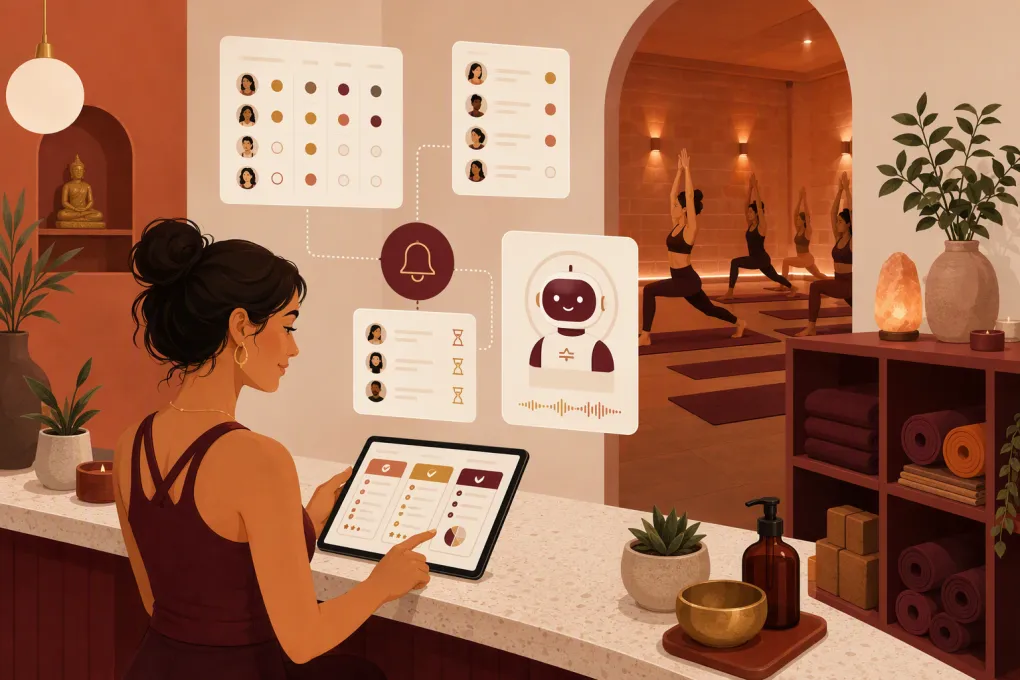
Most studio platforms can store a schedule and accept online bookings. The distinction for WTF Go is Fitty’s role as an AI receptionist and agent around those core workflows.
Once the relevant systems and policies are configured, Fitty can respond to routine inquiries, present eligible booking options, follow up with leads and support authorized dues-recovery workflows outside staffed hours. This can reduce dependence on a front-desk employee manually checking voicemail, form submissions and payment lists.
There are important prerequisites:
- Schedules, capacities and products must be accurate.
- Studio policies and approved answers must be configured.
- Booking access must be connected and authorized.
- Billing follow-up requires compatible payment and account workflows.
- The studio must decide when a conversation moves to a person.
- Sensitive, disputed or medically oriented questions require human handling.
“Pursuing dues continuously” does not mean charging arbitrary amounts or contacting members without controls. It means executing approved reminders and resolution steps around known account balances, subject to the studio’s configuration, payment setup and applicable communication requirements.
Ask WTF Go to map Fitty against your current booking and dues process →
Support and migration questions that expose real differences
Support quality can vary by package, implementation stage and issue type, so broad online claims are not enough. Ask every finalist for written answers to the same questions.
Support
- Is onboarding self-service, guided or handled by an implementation specialist?
- Which support channels are included in the proposed package?
- What are the stated support hours?
- How are payment or class-access emergencies escalated?
- Is multi-location configuration handled by a general queue or a named contact?
- Who supports third-party integrations when two vendors are involved?
Then submit a technical question during the sales process and evaluate the specificity of the answer—not merely its speed.
Migration
A vendor saying “we migrate your data” is not specific enough. Ask which fields transfer for:
- Client profiles and contact preferences
- Active memberships and remaining class credits
- Future bookings and waitlists
- Attendance history
- Signed waivers
- Account balances
- Autopay schedules
- Stored payment credentials
- Staff permissions
- Reporting history
Stored payment methods may not be portable between processors or platforms. Do not promise members a seamless billing transition until the outgoing vendor, incoming vendor and payment providers have confirmed the process.
How to make the final decision
Choose three finalists representing the operating model you actually need. For example, a single-location yoga-only studio might compare Mindbody, Momoyoga and Punchpass. A hot yoga and massage business might compare Mindbody, Vagaro and WellnessLiving. A growing operator focused on automated lead response might compare Mindbody, WTF Go and a boutique platform such as Momence or Mariana Tek.
Score each finalist on evidence from the demo:
- Can it execute the first-timer journey?
- Can it fill a waitlist under your rules?
- Can staff close a heated room quickly and communicate clearly?
- Can it manage your exact intro offers and memberships?
- Can it distinguish policies across locations and class formats?
- Can it follow up without creating another disconnected inbox?
- Can the vendor explain migration field by field?
- What will the complete setup cost, including add-ons and retained tools?
Do not award points for a feature that was mentioned but not demonstrated.
Mindbody may remain the right answer when its marketplace, existing integrations and familiar staff workflows produce more value than switching. A lighter yoga-specific platform can be better for a straightforward schedule. A broader wellness suite can fit studios combining classes with appointments. WTF Go is most relevant when the operational gap is not simply booking, but responding, following up and resolving routine revenue tasks when staff are unavailable.
See whether WTF Go fits your hot yoga studio’s actual workflows →
Frequently asked questions
What is the best Mindbody alternative for a small hot yoga studio?
There is no universal best option. Momoyoga, Punchpass and OfferingTree may suit simpler operations, while WTF Go is worth considering when after-hours inquiry handling and follow-up are priorities.
Can Fitty book hot yoga classes automatically?
Fitty can book within connected, authorized workflows when schedules, capacities, eligibility rules and studio policies are configured. Exceptions, unclear policies and sensitive questions should be escalated to staff.
Can stored payment information be migrated from Mindbody?
Not always. Portability depends on the platforms, payment processors and contractual arrangements, so obtain written confirmation before planning the billing transition.
Which features matter most for hot yoga studio software?
Prioritize strict capacity controls, waitlist promotion, format-specific memberships, first-timer instructions, closure communications, waivers, late-cancel rules and clear escalation for health-related questions.
Should a hot yoga studio leave Mindbody?
Only when a demonstrated alternative improves important workflows enough to justify migration cost and disruption. Staying can make sense when staff use Mindbody effectively and its marketplace or integrations provide meaningful value.
Keep reading



Run your gym on autopilot with WTF Go
Fitty — your AI receptionist — answers calls and DMs, fills classes, follows up with every lead, and collects dues while you coach.