Comparisons
Mindbody Alternative for EMS Fitness Studios: 2026 Guide
Find a Mindbody alternative for EMS fitness studios that handles session booking, memberships, lead follow-up, waivers, payments, and multi-location growth.
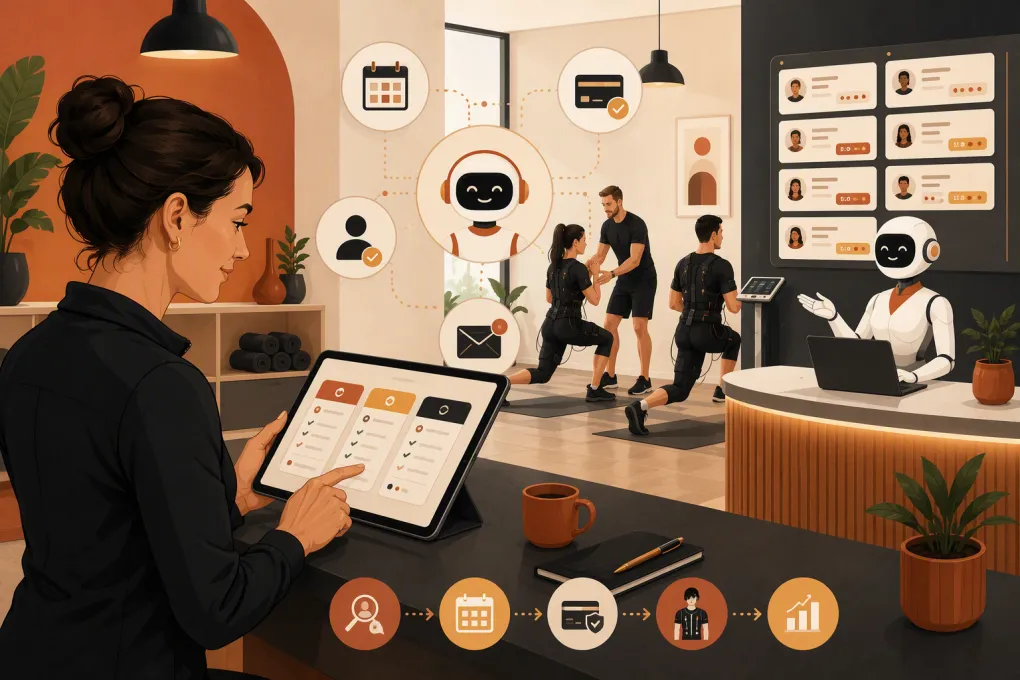 Watch · 20s
EMS fitness studios do not operate like conventional open gyms. You sell scheduled, staff-led sessions built around limited trainer time, EMS suits, cleaning windows and recurring memberships. That operating model changes what you should demand from a Mindbody alternative.
The right platform must do more than display a calendar and process payments. It should convert inquiries quickly, prevent unusable bookings, enforce membership rules, keep waivers organized and reduce the time your team spends chasing leads or failed dues.
Why EMS studios look beyond Mindbody
Mindbody is an established wellness platform with scheduling, payments, marketing tools and a consumer marketplace. Its breadth is useful for many gyms, salons and wellness businesses. It can also be more platform than a specialized EMS operator needs—or require configuration and add-ons to create the exact sales and booking workflow the studio wants.
Common reasons an EMS studio might evaluate alternatives include:
- Leads are not being contacted quickly enough after submitting a form.
- Front-desk staff repeatedly answer the same questions about sessions, suits and memberships.
- The booking setup does not adequately reflect trainer, room or equipment capacity.
- The studio wants more control over automated follow-up.
- Owners have to move between separate CRM, phone, booking and billing tools.
- Multi-location reporting or lead routing has become difficult to manage.
- The total software stack is hard to understand because important functions sit in different packages.
Changing software will not fix a poorly defined process. But it can remove manual work once your booking rules, sales stages and membership policies are clear.
See how Fitty handles EMS studio inquiries, booking and follow-up →
What an EMS studio management platform must handle
A generic feature checklist is not enough. Evaluate each option against the way a prospect actually becomes—and remains—a paying EMS member.
1. Consultation and first-session conversion
EMS prospects often have questions before booking. They may ask what to wear, how a session works, whether equipment is provided or whether they should speak with a trainer first.
Your software should support:
- Immediate responses to new inquiries
- Consultation or introductory-session booking
- Automated confirmations and reminders
- Lead status tracking
- Follow-up after missed calls, abandoned inquiries and no-shows
- Clear escalation to a staff member when a question requires human judgment
Speed matters operationally even without assigning a universal conversion statistic to it. A lead who receives a useful response while actively researching is easier to move forward than one contacted after the studio reopens.
2. Capacity beyond a simple calendar
An available time does not necessarily mean an EMS studio can accept another booking. Capacity may depend on trainers, rooms, suit inventory, device stations and the service format.
Map the constraints you need the system to enforce:
- One-to-one versus small-group sessions
- Maximum clients per trainer
- Room or station availability
- Buffers for changing, setup and sanitation
- Session eligibility based on membership or package
- Introductory-session restrictions
- Location-specific staff and equipment
Most fitness platforms are not EMS device-management systems. Do not assume they track suit inventory, maintenance or device telemetry simply because they support resource scheduling. Ask for a live demonstration of the exact setup you need.
3. Membership and session-credit rules
EMS memberships are often tied to a defined session frequency rather than unlimited facility access. The platform should make it easy to understand:
- How credits are issued and redeemed
- Whether unused sessions expire or roll over
- How freezes and cancellations work
- Whether members can book beyond their current allowance
- How upgrades, downgrades and add-on sessions are handled
- What happens after a failed recurring payment
The member, coach and owner should see the same answer. If staff need a spreadsheet to reconcile remaining sessions, the system is not doing enough.
4. Waivers and sensitive intake information
Your workflow may include liability waivers, informed-consent documents and pre-session screening. Confirm that forms can be completed before arrival, attached to the correct client record and reviewed by authorized staff.
Software can collect information, but it should not make medical eligibility decisions unless it is explicitly built and governed for that purpose. Establish a staff escalation process for pregnancy, implanted devices, recent procedures, health conditions or any other concern identified by your policies and qualified advisers.
5. Collections and failed-payment follow-up
Recurring revenue depends on more than running a card each month. Compare how each platform handles payment retries, member notifications, account status and staff tasks.
Look for a workflow that distinguishes between:
- An expired card
- A temporary decline
- A disputed charge
- A member requesting a freeze
- An account that should lose booking privileges
Automated outreach can handle routine reminders. Staff should own exceptions, disputes and sensitive conversations.
Mindbody alternatives for EMS fitness studios compared
The products below serve overlapping markets, but they are not interchangeable. Features, packaging and availability can change, so use this table to build a shortlist—not replace a tailored demo.
| Platform | Core workflows and booking | Automation and AI | Multi-location and integrations | Pricing approach | Best fit and potential limitation |
|---|---|---|---|---|---|
| WTF Go | All-in-one operations for gyms, studios and wellness businesses, including lead handling, booking and dues workflows | Fitty is an AI receptionist and agent that answers leads, books classes, follows up and helps collect dues 24/7 | Discuss location structure, permissions, reporting and required integrations during the demo | Request current pricing based on business requirements | Strong fit for operators trying to consolidate front-desk communication and follow-up. Confirm the precise resource, credit and EMS appointment rules you require. |
| Mindbody | Broad scheduling, memberships, payments, marketing and wellness marketplace capabilities | Automation is available across its platform and packages; evaluate the current AI and communication functionality directly | Broad ecosystem and support for growing wellness businesses | Package and add-on costs vary; request a current quote | Strong for businesses that value a mature wellness ecosystem and consumer discovery. Breadth, packaging or workflow complexity may be unnecessary for a focused EMS concept. |
| Glofox | Boutique fitness management with member booking, memberships, apps and lead-management functions | Offers automated member and lead communication; confirm current AI capabilities and channels | Designed for boutique fitness brands, including multi-location operators | Quote-based; packaging depends on requirements | Worth considering for class-led boutique brands. Test whether appointment-style EMS capacity and equipment constraints fit naturally. |
| WellnessLiving | Scheduling, memberships, payments, client management and marketing tools across fitness and wellness | Includes business automation and client communication features; validate the exact workflow in a demo | Supports multi-location businesses and a range of integrations | Plan and feature packaging varies | Broad feature set for operators wanting many functions in one platform. The tradeoff can be additional setup and training. |
| Zen Planner | Membership, billing, attendance and scheduling for fitness businesses and other membership-based facilities | Supports standard communication and operational automation; assess whether it replaces a separate conversational sales tool | Suitable for established membership operations; confirm location structure and required integrations | Current pricing depends on the selected product and services | Useful for membership and attendance fundamentals. EMS studios should test consultation booking, resource constraints and lead nurturing in detail. |
| Vagaro | Appointment scheduling, payments, forms, marketplace exposure and business management across beauty, wellness and fitness | Provides notifications, marketing and operational automation; confirm conversational AI requirements | Supports multiple service providers and locations, with optional features | Public plans and add-ons may vary by provider, location and feature | A practical candidate when the EMS model resembles an appointment-based wellness business. Validate recurring session-credit and boutique fitness membership rules. |
Where WTF Go and Fitty fit the EMS model
An EMS studio does not necessarily need more software features. It needs fewer dropped handoffs.
Consider what happens when a prospect submits an inquiry at night. A disconnected stack may create a CRM record, send a generic email and leave a task for the next shift. By then, the prospect may have contacted several other studios.
Fitty is designed to work as an always-available AI receptionist and agent. It can answer routine lead questions, help book the appropriate class or next step, continue follow-up and assist with dues collection. That is particularly relevant to EMS studios, where owners and coaches are often training clients rather than watching the phone.
The operational objective is not to remove people from the process. It is to reserve staff time for work requiring judgment:
- Discussing an unusual health or eligibility concern
- Resolving a disputed charge
- Recommending the right membership after an assessment
- Recovering a dissatisfied member
- Coaching a first-time client through the experience
Routine questions, reminders and booking actions should not depend on a coach becoming available between sessions.
See how WTF Go can consolidate your EMS lead-to-member workflow →
How to demo an alternative without getting a generic sales tour
Give every vendor the same scenarios and ask the representative to complete them live. Do not accept a slide saying the platform supports a feature.
Use these tests:
- New evening lead: A prospect asks how EMS works and wants an introductory session. Show the response, qualification, booking and staff notification.
- Capacity conflict: A trainer is available, but the applicable room, station or suit category is not. Show whether the booking is blocked.
- No-show recovery: A first-time prospect misses a consultation. Show the automated follow-up and rebooking path.
- Credit enforcement: A member has used the sessions included in the current period. Show what the member sees when attempting another booking.
- Failed payment: A recurring charge fails. Show retries, communication, account status and staff escalation.
- Medical question: A lead asks whether EMS is appropriate for a specific condition. Show how automation avoids making an unsupported determination and routes the conversation to staff.
- Location transfer: A member wants to book at another studio. Show permissions, pricing, credits and reporting.
- Owner reporting: Show leads by source, booked introductions, sales status, active members, failed payments and location-level performance.
Also ask who configures these workflows, how long changes take and whether your team can edit them without submitting a support ticket.
Plan the migration around operating rules, not data files
A vendor may be able to import contacts, but migration quality depends on the condition of your current data. Before switching, document:
- Active memberships and remaining credits
- Contract terms, freezes and cancellation requests
- Unpaid balances and failed-payment status
- Signed waivers and form-retention requirements
- Future appointments and waitlists
- Staff schedules and permissions
- Lead sources, stages and follow-up ownership
- Duplicate, inactive and incomplete client records
Confirm which data can be migrated, which must be archived and which payment credentials can transfer under the processors’ rules. Keep access to required historical records, and do not cancel the old platform until future bookings, billing dates and member balances have been reconciled.
Run a controlled test with staff accounts and sample members. Then train coaches on exceptions, not just routine check-in. They need to know what to do when a credit looks wrong, a waiver is missing or an automated conversation requires human intervention.
Book a WTF Go walkthrough built around your actual EMS booking and collections rules →
Choose the platform that removes operational friction
The best Mindbody alternative for an EMS fitness studio is the one that accurately reflects your capacity, membership and sales model while reducing manual follow-up. Marketplace reach may matter to one operator; AI-led response and consolidated workflows may matter more to another.
Build your shortlist from real operating constraints, test the same scenarios with every vendor and calculate the full stack you would still need after implementation. A lower software subscription is not a better deal if staff must compensate with inboxes, spreadsheets and missed follow-up.
Frequently asked questions
What software features are most important for an EMS fitness studio?
Prioritize consultation booking, trainer and resource capacity, session-credit memberships, waivers, recurring billing, lead follow-up and failed-payment workflows. Test each feature using your actual operating rules.
Can gym software track EMS suits and equipment?
Some platforms can model equipment as bookable resources, but that does not mean they manage suit inventory, sanitation, maintenance or device telemetry. Ask the vendor to demonstrate your exact resource setup.
Is Mindbody a good fit for an EMS studio?
It can be, especially for operators that value a broad wellness ecosystem and marketplace presence. Studios seeking a simpler workflow or more integrated AI-led lead response should compare alternatives against the full cost and configuration required.
How does Fitty help an EMS fitness studio?
Fitty acts as a 24/7 AI receptionist and agent that answers leads, books classes, follows up and helps collect dues. Staff can focus on coaching and conversations that require human judgment.
What should be migrated when changing studio software?
Plan for client records, memberships, credits, balances, waivers, future bookings, staff permissions and active leads. Confirm payment-token portability and historical-record requirements before closing the old system.
Keep reading
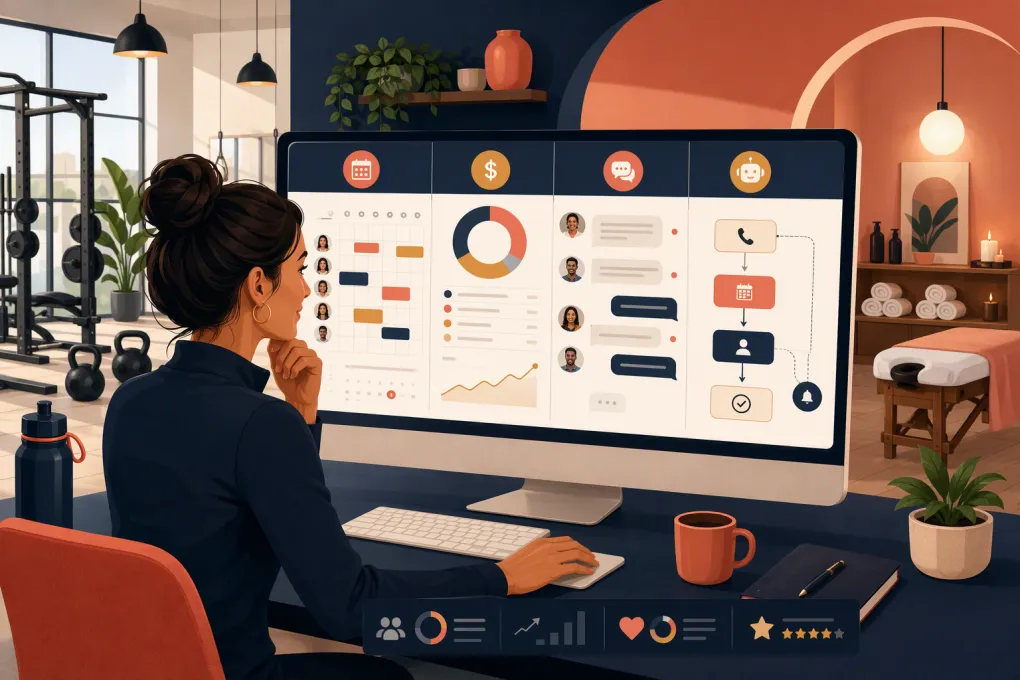


Run your gym on autopilot with WTF Go
Fitty — your AI receptionist — answers calls and DMs, fills classes, follows up with every lead, and collects dues while you coach.