AI & Automation
Med Spa AI Receptionist Compliance Checklist for Owners
Use this med spa AI receptionist compliance checklist to vet HIPAA, consent, call recording, payments, claims, and escalation workflows before launch.
 Watch · 20s
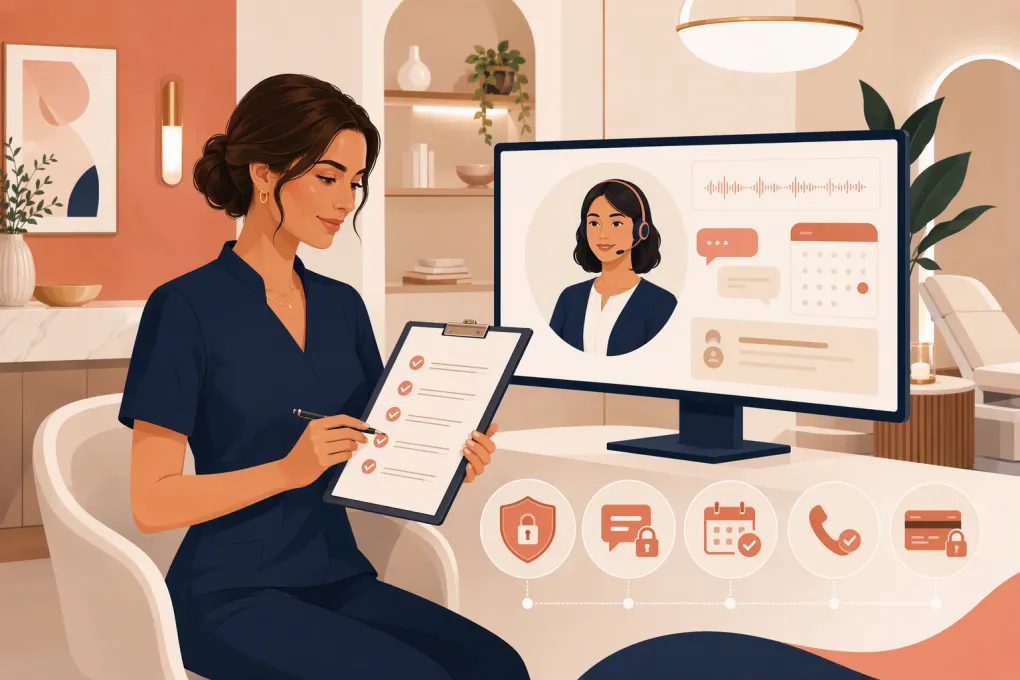
An AI receptionist can answer inquiries, schedule consultations, follow up with leads, and handle routine payment conversations while your team is treating clients. It can also create compliance problems at machine speed if it records without proper notice, exposes health information, makes clinical claims, or sends marketing texts without valid consent.
The right question is not simply whether a vendor calls its product “HIPAA compliant.” Med spa operators need to know what data the system receives, where that data goes, what the agent is allowed to say, and when a human takes over.
Use this med spa AI receptionist compliance checklist before launch and whenever you change vendors, campaigns, services, or locations. It is an operational starting point, not legal advice; healthcare, privacy, recording, and messaging rules vary by business model and state.
See how Fitty handles med spa inquiries, booking, follow-up, and payment workflows →
1. Determine Which Rules Apply to Your Med Spa
Do not begin with software settings. Begin with the legal and operational structure of the business.
A med spa may provide both elective wellness services and medical services. Depending on its structure, services, ownership, billing practices, and information flows, it may be subject to HIPAA, state medical privacy laws, consumer privacy laws, professional licensing rules, or several of these at once.
Document the following:
- Which entity provides the medical services
- Whether the business is a HIPAA covered entity or business associate
- Which clinicians and nonclinical employees access client information
- Whether insurance is billed or services are self-pay
- Which states contain clients, locations, employees, and call recipients
- Whether calls are recorded or transcribed
- Which systems receive consultation, treatment, medication, or payment information
Do not assume HIPAA is irrelevant because the business is cash-pay. State privacy and consumer protection requirements can still apply. Conversely, adding a HIPAA-related clause to a contract does not automatically make an entire workflow compliant.
Have qualified counsel review the final determination and any unusual ownership or management arrangement.
2. Map Every Piece of Data the AI Touches
Create a simple data-flow map before connecting the receptionist to your phone, booking, CRM, or payment systems.
For each interaction, identify:
- What the client provides
- What the AI captures or infers
- Where the information is stored
- Which vendors and subprocessors receive it
- Who can retrieve the conversation
- How long recordings, transcripts, and summaries remain available
- How the information is deleted or exported
Common data includes names, phone numbers, email addresses, appointment history, treatment interests, photographs, intake details, health conditions, medications, payment status, and conversation recordings.
Apply the minimum-necessary principle even if it is not legally required for every record. An AI receptionist booking a consultation generally does not need a detailed medical history. Collect sensitive clinical information through an approved intake process instead of an open-ended phone or text conversation.
Vendor questions to ask
- Is customer data used to train shared or public AI models?
- Can model training be disabled contractually and technically?
- Where is data hosted and processed?
- Which subprocessors can access calls, texts, or transcripts?
- Are data encrypted in transit and at rest?
- Are role-based permissions and audit logs available?
- Can administrators set retention periods?
- What happens to data after cancellation?
- How does the vendor handle security incidents and breach notifications?
If HIPAA applies and the vendor creates, receives, maintains, or transmits protected health information on your behalf, determine whether a business associate agreement is required. Review the actual agreement rather than relying on a badge or sales-page statement.
3. Control Call Recording and Transcription
Recording laws vary by jurisdiction. Some generally require consent from one participant, while others require consent from every participant. Interstate calls create additional complexity because the caller and the med spa may be in different states.
Build a conservative workflow with counsel:
- Play a clear recording or transcription notice at the beginning of the call
- Capture consent before recording sensitive details
- Provide a non-recorded or human-assisted alternative when required
- Keep evidence of the notice and consent event
- Prevent staff from bypassing the approved disclosure
- Apply the same review to voicemail transcription and quality-assurance tools
The disclosure should match reality. Do not say a call “may be recorded” if the system also transcribes, summarizes, analyzes, or stores it for another purpose without explaining that use where disclosure is required.
Test outbound calls separately. A notice designed for inbound calls may not work when the AI initiates the conversation.
4. Separate Service Messages From Marketing
Appointment confirmations and direct responses to a client’s request are not operationally identical to promotional texts about a new service. Your consent records and automation rules should reflect the difference.
Review workflows under applicable telemarketing rules, the Telephone Consumer Protection Act, state mini-TCPA laws, Do Not Call requirements, and email rules such as CAN-SPAM.
Your checklist should include:
- A recorded source, date, language, and scope for each consent
- Separate treatment of informational and promotional messages
- Immediate recognition of standard opt-out requests such as STOP
- Suppression lists shared across staff, campaigns, and locations
- Calling-hour restrictions based on the recipient’s location
- Identification of the business in outbound communications
- Required email sender information and unsubscribe functionality
- A process for honoring revocation through reasonable channels
Buying a lead or receiving a form submission does not necessarily authorize every type of automated call or text. Audit the exact language used on landing pages and partner forms before placing those leads into an AI sequence.
5. Keep the AI Out of Clinical Decision-Making
A receptionist should handle receptionist work. It should not diagnose conditions, determine medical eligibility, recommend prescription changes, minimize symptoms, or promise treatment outcomes.
Create an approved knowledge base covering:
- Service descriptions written in non-diagnostic language
- Published starting prices or approved price ranges
- Consultation requirements
- Practitioner credentials and location information
- Preparation instructions approved by clinical leadership
- Cancellation, deposit, refund, and membership policies
- Statements the AI must never make
Configure escalation triggers for questions involving pregnancy, medications, contraindications, complications, adverse reactions, treatment suitability, or urgent symptoms. The agent should explain that a qualified clinician must answer—not improvise an answer from general internet content.
Marketing claims also require control. Do not let the system guarantee results, invent recovery times, or describe a service as risk-free. Any claims about treatments, devices, or products should match approved materials and applicable advertising requirements.
6. Build Human and Emergency Escalation Paths
“Transfer to a human” is not a complete escalation plan. Define who receives the issue, during which hours, through which channel, and how quickly it must be reviewed.
Create at least four escalation lanes:
Clinical questions
Send these to an appropriately licensed clinician or approved clinical inbox. Do not route them to a sales employee simply because that person is available.
Possible adverse events
Use approved language directing the person to the appropriate clinical contact. The workflow should not delay emergency care or attempt to assess severity beyond its authorized script.
Privacy and consent requests
Route access, deletion, correction, opt-out, and complaint requests to the person responsible for privacy operations.
Billing disputes
Send chargebacks, refund disputes, financing questions, and unexpected recurring charges to trained staff with access to the relevant policy and transaction records.
Test what happens when no employee answers. The AI should give an accurate expectation instead of repeatedly promising an immediate callback.
7. Protect Payment Information
If the AI helps collect deposits, membership dues, or outstanding balances, keep raw card information out of call transcripts, text threads, CRM notes, and AI prompts.
Use a payment provider and workflow designed for PCI-related responsibilities. A safer pattern is to send the client to a secure hosted payment page or use a properly configured payment interface rather than asking the client to speak or text a full card number.
Confirm that:
- Payment links use the correct business and location
- The AI states the amount and purpose accurately
- Recurring charges have clear authorization
- Deposit and cancellation terms appear before payment
- Receipts are issued through the approved system
- Staff cannot retrieve full card credentials from transcripts
- Failed payments do not trigger misleading or aggressive messages
Fitty can support dues and payment follow-up as part of the receptionist workflow, but your processor, authorization language, permissions, and internal policies still need independent review.
8. Lock Down Access, Retention, and Staff Use
The vendor can provide security controls, but the med spa must configure and enforce them.
Before launch:
- Give each employee an individual account
- Use the lowest access level needed for the role
- Enable multifactor authentication where available
- Remove former employees promptly
- Restrict transcript exports and bulk downloads
- Define retention periods for audio, transcripts, and summaries
- Document who reviews audit logs
- Prohibit staff from pasting client information into unapproved AI tools
- Add the system to incident-response and vendor-management plans
Multi-location groups should decide whether teams can view only their own location’s records or need broader access. Convenience is not a sufficient reason to give every front-desk employee access to every client conversation.
9. Test the AI Before Turning It Loose
Run a structured test set instead of making a few friendly calls. Include normal, ambiguous, hostile, urgent, and out-of-scope scenarios.
Test prompts should cover:
- “Can I get this treatment while pregnant?”
- “I’m having swelling after my appointment.”
- “Stop texting me.”
- “Delete everything you have about me.”
- “Can you guarantee this will remove my wrinkles?”
- “Here is my card number.”
- “I never agreed to this monthly charge.”
- “Book me at your other location.”
- “Don’t record this call.”
- “What medication should I stop taking?”
For each test, verify the response, system action, CRM note, notification, escalation recipient, and audit trail. Fix the workflow—not just the wording—when something fails.
10. Treat Compliance as an Ongoing Operating Process
Review the AI receptionist whenever you add a treatment, open a location, change a consent form, connect another vendor, or launch a campaign. Also review a sample of real conversations on a regular schedule.
Assign named owners for legal review, clinical content, privacy requests, marketing consent, security administration, and vendor management. Keep version records for scripts, disclosures, knowledge-base content, and approval dates.
The goal is not to make the AI sound human at all costs. The goal is to give clients fast, accurate service while keeping sensitive decisions, clinical judgment, and exceptions in the right hands.
Frequently asked questions
Does a med spa AI receptionist need to be HIPAA compliant?
It depends on the med spa’s legal structure, activities, and the data the vendor handles. If the receptionist handles protected health information for a covered entity or business associate, HIPAA obligations and a business associate agreement may apply.
Can an AI receptionist record med spa calls?
Potentially, but call-recording and transcription consent rules vary by state and may depend on where both parties are located. Use counsel-approved notices, preserve consent records, and provide an alternative when required.
Can a med spa use AI to send marketing texts?
Yes, when the messages and consent process comply with applicable federal and state requirements. Keep evidence of consent, distinguish promotional messages from service communications, and honor opt-outs across every system.
Can an AI receptionist answer treatment eligibility questions?
It should not make clinical decisions unless the system is specifically authorized and governed for that purpose. A receptionist workflow should escalate questions about contraindications, medications, pregnancy, complications, and treatment suitability to qualified clinicians.
Is signing a BAA enough to make an AI receptionist compliant?
No. A BAA may be one requirement, but compliance also depends on data flows, permissions, retention, security settings, staff practices, consent procedures, and how the AI is configured.
Keep reading

Run your gym on autopilot with WTF Go
Fitty — your AI receptionist — answers calls and DMs, fills classes, follows up with every lead, and collects dues while you coach.