AI & Automation
Choosing a HIPAA Compliant AI Receptionist for Med Spas
Learn how to choose a HIPAA compliant AI receptionist for med spas, vet vendors, protect patient data, and automate booking without compliance shortcuts.
 Watch · 20s
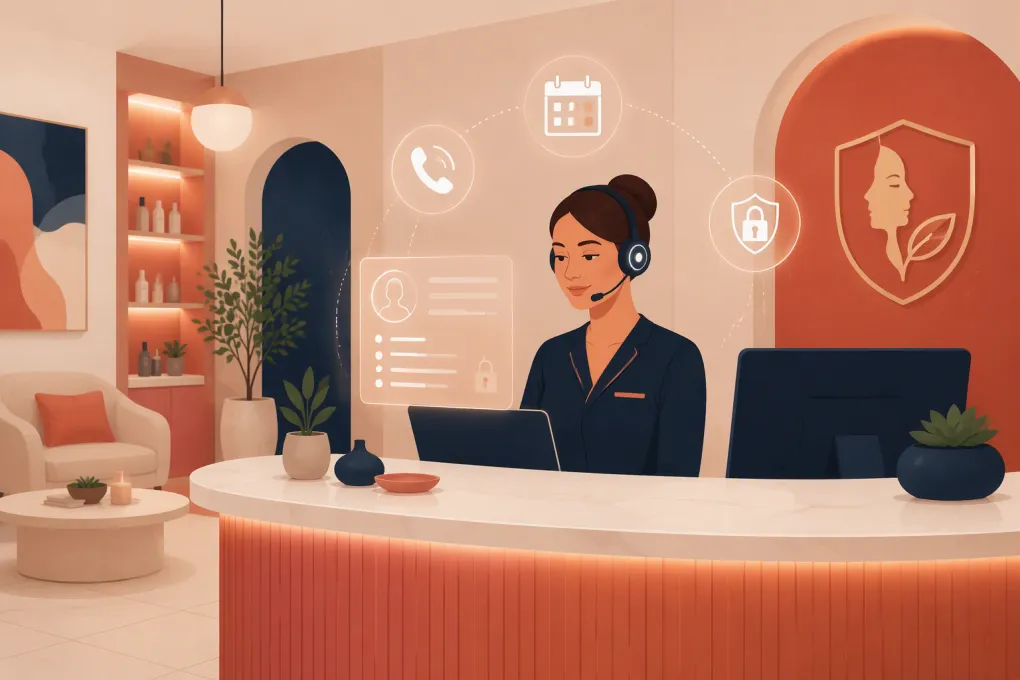
A med spa receptionist handles more than a ringing phone. One conversation can include a prospective patient’s name, treatment interests, appointment history, medications, contraindications, financing questions, and post-procedure concerns. An AI receptionist can take significant pressure off the front desk—but only if the system, vendor agreements, and day-to-day workflows are built around the right privacy boundaries.
That is why choosing a HIPAA compliant AI receptionist for med spas is not as simple as finding software with a security badge on its website. You need to know what information the AI receives, where that information goes, who can access it, and what happens when a caller asks a clinical question.
First, determine whether HIPAA applies to your med spa
Not every med spa operates under exactly the same regulatory framework. HIPAA generally applies to covered entities and their business associates. Whether a particular med spa is a covered entity can depend on its services, business structure, healthcare providers, and whether it conducts certain covered electronic transactions.
A med spa that is not a HIPAA covered entity may still have obligations under state medical privacy laws, consumer privacy laws, breach-notification rules, professional licensing requirements, and contractual commitments. Some state requirements reach more broadly than HIPAA.
Do not use the absence of insurance billing as your only test. Have qualified healthcare counsel or a privacy professional determine:
- Which parts of the business are subject to HIPAA
- Whether clinical and nonclinical entities share systems or staff
- Which communications contain protected health information, or PHI
- Which vendors are business associates
- Which state privacy and call-recording laws also apply
Once that scope is clear, you can configure the AI receptionist around the actual risk instead of guessing.
What “HIPAA compliant” should mean in practice
HIPAA does not provide a government seal that certifies an AI receptionist as compliant in every possible use. Compliance depends on both the vendor’s safeguards and how the med spa deploys the technology.
A credible vendor should be able to explain its role without hiding behind vague phrases such as “HIPAA-ready” or “bank-level security.” Your review should cover the following areas.
A business associate agreement
If a vendor creates, receives, maintains, or transmits PHI on behalf of a covered entity, a business associate agreement may be required. The BAA should identify permitted uses, safeguarding obligations, breach responsibilities, subcontractor requirements, and what happens to PHI when the relationship ends.
Ask whether the agreement covers the complete service—not just one database while excluding call recordings, transcripts, messaging tools, analytics, support access, or AI subprocessors.
A documented data flow
You should be able to trace information from the moment a patient calls or sends a message. Map:
- The phone, web chat, SMS, or messaging channel used
- Audio recording and transcription systems
- The AI model or processing layer
- Appointment scheduling and CRM records
- Notifications sent to employees
- Reporting, backups, and log storage
- Third-party subprocessors with potential data access
If neither the vendor nor your team can explain where a transcript is stored, you cannot assess the exposure.
Access and authentication controls
The system should support access based on job responsibilities. A receptionist may need scheduling details, while a clinician may need the full patient handoff. Former employees should lose access promptly, and shared logins should be avoided.
Ask about unique user accounts, multifactor authentication, permission levels, audit logs, session controls, and procedures for vendor support access.
Encryption, retention, and deletion
Confirm how information is protected in transit and at rest. Then examine retention. Keeping every recording and transcript indefinitely creates unnecessary exposure.
Set retention periods according to clinical, legal, operational, and insurance requirements. The vendor should also be able to explain deletion procedures, backups, legal holds, and data export when you leave the platform.
Restrictions on AI model training
Ask directly whether your calls, messages, transcripts, or patient records are used to train shared or public models. Do not settle for an answer that covers only names and ignores the rest of the conversation.
The contract and technical configuration should align. A verbal promise from a salesperson is not a substitute for documented terms.
Separate scheduling from clinical decision-making
An AI receptionist can manage many repetitive front-desk tasks without acting like a clinician. The safest workflow gives the AI clear authority, prohibited actions, and escalation rules.
| Patient request | Appropriate AI role | Required guardrail |
|---|---|---|
| “Do you offer laser hair removal?” | Provide approved service information | Use current, management-approved content |
| “Can I book a consultation Tuesday?” | Check availability and book | Collect only information required for scheduling |
| “Am I a candidate if I take this medication?” | Escalate to a qualified person | Do not provide individualized clinical advice |
| “My swelling is getting worse after treatment.” | Trigger an urgent handoff | Follow the med spa’s clinical escalation protocol |
| “Can you charge the card on file?” | Initiate an approved payment workflow | Keep payment-card handling within a PCI-compliant process |
| “Send my records to another provider.” | Route the request | Follow identity verification and records-release procedures |
The system should not improvise answers about candidacy, contraindications, medication changes, expected complications, or emergency care. Build scripts that acknowledge the question and connect the patient to the appropriate licensed professional.
For potential emergencies, the workflow should provide the med spa’s approved instructions rather than relying on open-ended AI judgment.
Configure the minimum necessary information
More data does not automatically create a better booking experience. For an initial inquiry, the AI may only need a name, contact method, requested service, preferred location, and availability.
Avoid collecting detailed medical histories during an ordinary lead conversation unless the workflow truly requires them and the channel is approved for that purpose. Clinical intake can be moved to the appropriate secure process after the appointment is scheduled.
This also makes conversations shorter. A lead asking about a facial or injectable consultation should not face a lengthy medical interview before seeing available times.
Your scripts should define:
- Information the AI can collect during lead qualification
- Information reserved for clinical intake
- Identity checks required before disclosing appointment details
- Words or scenarios that trigger human review
- Which staff member receives each escalation
- What happens when nobody responds after hours
Walk through your med spa’s call, booking, follow-up, and escalation workflow with WTF Go →
Do not overlook phone, text, and payment rules
HIPAA is only one part of the compliance picture.
Call recording and transcription
State laws differ on consent to record calls. If calls are recorded or transcribed, determine when disclosure or consent is required and use a greeting approved for the jurisdictions where you operate and receive calls.
Also decide whether every call needs to be recorded. In some workflows, structured notes may be sufficient and less sensitive than storing full audio.
Automated text messages
Appointment confirmations, lead follow-up, and promotional campaigns do not all carry the same legal considerations. Document consent, honor opt-outs, identify the business, and separate operational messages from marketing where appropriate. Have counsel review your practices under applicable federal and state telemarketing rules.
Keep message previews in mind as well. A detailed treatment reminder can appear on a locked phone screen where another person sees it.
Payment collection
HIPAA compliance does not replace payment-card security. If the receptionist collects deposits, membership dues, or outstanding balances, use an appropriate payment processor and avoid placing full card details in call transcripts, CRM notes, or ordinary messages.
Fitty is designed to help businesses answer leads, book appointments, follow up, and collect dues around the clock. For a med spa, those workflows should be configured with explicit PHI boundaries, approved scripts, secure handoffs, and the agreements your legal review requires.
See how Fitty can automate med spa front-desk work without losing control of the patient handoff →
Questions to ask every AI receptionist vendor
Use the same written questionnaire for each vendor so you can compare answers rather than sales presentations.
- Will you sign a BAA when the workflow requires one?
- Which products, communication channels, and subprocessors does that BAA cover?
- Where are recordings, transcripts, messages, and backups stored?
- Is customer data used to train shared AI models?
- Which employees or contractors can access customer data?
- What authentication, permissions, and audit logs are available?
- Can we configure retention and request permanent deletion?
- How does the system escalate clinical, urgent, or uncertain questions?
- Can sensitive fields be excluded from notifications and transcripts?
- How are security incidents reported and investigated?
- What happens to our data when the contract ends?
- Can you provide current security and privacy documentation for review?
Treat incomplete answers as unfinished due diligence. A polished demo cannot compensate for an unclear data-handling model.
Roll out the receptionist in controlled stages
Do not automate every patient conversation on day one. Start with a narrow, measurable workflow.
Stage 1: General information and lead capture
Load approved hours, locations, services, provider availability, parking instructions, consultation policies, and frequently asked nonclinical questions. Review every answer for accuracy.
Stage 2: Appointment booking
Connect scheduling only after confirming appointment types, durations, buffers, provider rules, cancellation policies, and location constraints. Test duplicate patients, rescheduling, no availability, and requests involving multiple services.
Stage 3: Follow-up and payments
Add reminders, missed-call follow-up, deposits, and balance collection using approved channels and payment workflows. Confirm consent and opt-out handling before launching campaigns.
Stage 4: Escalations and quality review
Test medication questions, adverse reactions, angry callers, language barriers, record requests, minors, emergencies, and requests the AI cannot understand. Assign an owner to review transcripts or structured outcomes and update scripts.
A HIPAA compliant AI receptionist for med spas is not a set-it-and-forget-it answering bot. It is an operating workflow. The med spa remains responsible for policies, workforce training, access management, risk analysis, and ongoing oversight. The right platform makes those responsibilities easier to execute—but it does not eliminate them.
Frequently asked questions
Does every med spa need a HIPAA compliant AI receptionist?
Not every med spa is necessarily a HIPAA covered entity, but other federal and state privacy rules may still apply. Have qualified counsel determine your status and requirements before sending patient information through an AI system.
Does signing a BAA automatically make an AI receptionist HIPAA compliant?
No. A BAA is important when required, but compliance also depends on security controls, data flows, employee access, retention, training, policies, and how the med spa configures the system.
Can an AI receptionist answer treatment or medication questions?
It can provide approved general information, but individualized questions about candidacy, medications, contraindications, complications, or treatment decisions should be escalated to qualified clinical staff.
Can a med spa use AI for appointment reminders and follow-up texts?
Yes, if the messaging workflow follows applicable privacy, consent, opt-out, and telemarketing requirements. Avoid unnecessary treatment details in messages and lock-screen previews.
What should a med spa test before launching an AI receptionist?
Test booking rules, identity verification, clinical escalations, urgent calls, payment handling, consent, opt-outs, unavailable appointments, data retention, and human handoffs before expanding automation.
Keep reading
Run your gym on autopilot with WTF Go
Fitty — your AI receptionist — answers calls and DMs, fills classes, follows up with every lead, and collects dues while you coach.