Comparisons
Gymdesk Alternative for Climbing Gyms: Best Software Compared
Compare Gymdesk alternative options for climbing gyms by workflows, pricing, deployment, integrations, automation, and migration risk before switching.
 Watch · 20s
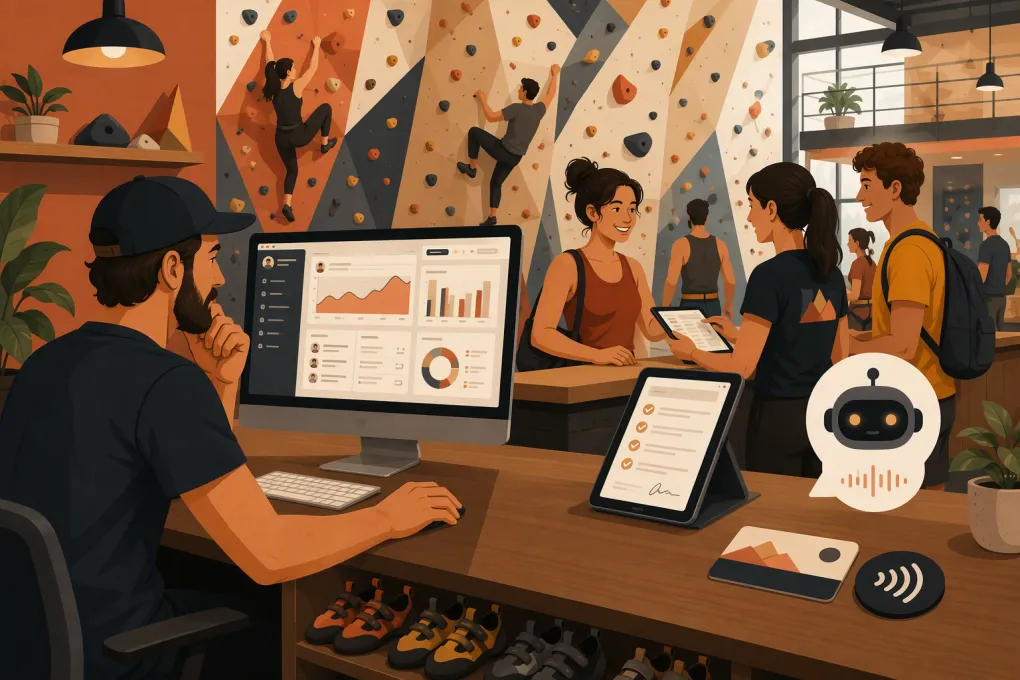
Gymdesk handles the core jobs many fitness facilities expect from management software: memberships, billing, scheduling, attendance, waivers and point-of-sale activity. The reason to seek a Gymdesk alternative for a climbing gym is not that those fundamentals are missing. It is usually that a specific part of the operation—climbing-specific front-desk workflows, deployment, lead response, multi-location control or integrations—needs a better fit.
Climbing gyms have an unusual operating mix. A single customer record may involve a day pass, rental equipment, a minor’s waiver, a household account, a class booking and an eligibility requirement. At the same time, staff must answer beginner questions, monitor the floor and process a line at the desk.
The right alternative should remove friction from that mix, not merely move it to a different interface.
See how Fitty handles climbing gym inquiries, bookings and follow-up →
How this comparison was researched
Research date: September 3, 2026.
This comparison uses publicly available vendor product pages, feature descriptions, pricing pages and support materials. We evaluated each platform against the same operational categories:
- Memberships and recurring billing
- Day passes, check-in, waivers and point of sale
- Classes, appointments and event booking
- Climbing-specific workflows
- Lead response and customer automation
- Deployment and hardware constraints
- Integrations and multi-location suitability
- Published versus sales-led pricing
We did not conduct a paid implementation or hands-on security audit of every product. Vendor-owned sources establish advertised capabilities, not how well a feature will perform in your facility. Features, packages and processing terms can also change after the research date.
Official sources used include Gymdesk’s features and pricing page, the Rock Gym Pro product site, the Approach product site, Mindbody for businesses and the WTF Go product site.
Gymdesk alternatives at a glance
| Platform | Core fit | Deployment | Pricing model | Integrations and automation | Main advantage | Main limitation |
|---|---|---|---|---|---|---|
| Gymdesk | General gym membership, billing, booking, attendance, waivers and POS | Cloud-based; accessed through web-connected devices | Publishes subscription tiers based on business size and plan scope | Offers integrations and built-in communication tools; automation focuses on normal gym-management workflows | Broad operational coverage with public pricing information | Not built specifically around climbing certifications, rental workflows or climbing terminology |
| Rock Gym Pro | Climbing-focused check-in, memberships, waivers, POS and facility operations | Core system uses a Windows-oriented workstation environment, with connected online services | Commercial subscription and service costs are provided through the vendor rather than a simple consumer-style checkout | Climbing-specific connected services are the focus; integration breadth is narrower than large general wellness ecosystems | Deep alignment with established climbing gym front-desk workflows | More workstation administration and deployment complexity than browser-first SaaS platforms |
| Approach | Cloud-based management designed specifically for climbing facilities | Browser-first cloud software | Sales-led pricing rather than a broadly published self-service price list | Combines climbing operations with online customer workflows; integration availability should be matched against your accounting, access and marketing stack | Modern, climbing-specific product design without relying on a general fitness model | Smaller ecosystem than broad fitness platforms, and costs require a vendor conversation |
| Mindbody | Broad fitness and wellness scheduling, payments, marketing and consumer discovery | Cloud platform with staff and consumer applications | Package and quote-based pricing; advanced capabilities may depend on plan or add-on | Large wellness-oriented ecosystem, consumer marketplace and business integrations | Strong fit for facilities mixing climbing with yoga, fitness, recovery or appointment services | Climbing-specific concepts may require custom processes or separate tools |
| WTF Go | Gym operations plus AI-assisted lead handling, booking follow-up and dues outreach | Cloud operating system with Fitty as an AI receptionist/agent | Sales-led pricing based on the selected operating scope | Fitty handles configured conversations and workflows continuously; integration scope must be established during implementation | Extends automation into unanswered inquiries and follow-up work | Not climbing-specific, and AI does not replace staff judgment, safety decisions or exception handling |
1. Rock Gym Pro: best for established climbing-specific workflows
Rock Gym Pro is the most direct category-specific comparison. It was developed around climbing gym operations rather than adapting a general studio platform to climbing.
That distinction matters at the front desk. Climbing facilities need to combine customer records, visits, memberships, waivers, point-of-sale transactions and climbing-related activities in one operating flow. A climbing-native data model generally requires fewer naming workarounds than software organized primarily around recurring fitness classes.
The tradeoff is deployment. Rock Gym Pro’s core environment is more workstation-oriented than a browser-only SaaS platform. That can introduce responsibilities around compatible Windows hardware, local networking, updates and connected services. Operators should include whoever manages their computers in the evaluation rather than treating implementation as a front-desk project alone.
Strongest fit: Established climbing gyms that value mature, climbing-specific desk workflows over a purely browser-based experience.
Watch for: Workstation requirements, remote access, online-service dependencies and how data is shared across multiple locations.
2. Approach: best for cloud-first, climbing-specific management
Approach occupies a useful middle ground: it is built for climbing businesses but follows a modern cloud-software model.
Its climbing focus makes it more relevant than a generic studio tool when evaluating member management, waivers, point of sale, check-in and programming. Its browser-first deployment also reduces dependence on a specific front-desk computer and can make remote management easier.
The principal buying issue is not whether it understands climbing. It is whether its surrounding ecosystem matches your operation. Build a written list of required accounting, door access, payment, marketing and reporting connections. Ask Approach to identify which are native integrations, which use an API or export, and which require manual work.
Pricing is sales-led, so operators need a complete proposal covering locations, users, onboarding, payment processing, messaging and any premium modules.
Strongest fit: Climbing gyms seeking a cloud-native platform without giving up industry-specific workflows.
Watch for: Integration coverage, data export options, implementation fees and the exact controls available to multi-location operators.
3. Mindbody: best for mixed climbing and wellness businesses
Mindbody is not climbing-specific. Its strength is a broad fitness and wellness platform encompassing scheduling, payments, client management, marketing tools and consumer discovery.
That can be useful when climbing is only one part of the business. A facility that also sells yoga, personal training, massage, recovery appointments or other scheduled services may benefit from a platform designed to support several wellness categories.
The compromise is operational specificity. Belay status, climbing orientations, rental packages and specialized access rules are not the concepts around which Mindbody was designed. A feature may be reproducible through products, forms, notes or custom procedures, but that is not the same as having a native climbing workflow.
Mindbody uses package-based, sales-led pricing. Request a line-item proposal because marketing, branded applications, messaging and other capabilities may depend on the selected package or additional services.
Strongest fit: Multi-service facilities where broad wellness scheduling and customer discovery matter more than climbing-native administration.
Watch for: Add-on costs, staff complexity and the number of workarounds needed for climbing permissions, rentals and day-use transactions.
4. WTF Go: best when lead handling is the operational gap
WTF Go is an all-in-one operating system for gyms, studios, spas and wellness businesses. Its defining difference is Fitty, an AI receptionist/agent designed to answer leads, help book classes, conduct follow-up and pursue dues collection.
The precise scope matters. “24/7” means the automated agent can remain available outside staffed desk hours for conversations and workflows configured in the system. It does not mean every question will be resolved, every booking can be completed regardless of business rules, or every unpaid balance will be recovered. Safety questions, unusual account disputes, refunds and policy exceptions still require staff escalation.
Likewise, “collects dues” refers to supporting configured payment-recovery outreach and directing or moving members through the available payment process. It is not a collections-agency service and cannot guarantee payment. Those boundaries should be defined during implementation, along with approved responses, escalation rules and system access.
The advantage is clearest when a gym’s main problem occurs before or after the front-desk transaction: unanswered evening calls, slow web-lead response, incomplete introductory bookings or managers manually following up on overdue accounts. The product claim and scope come from WTF Go’s official product information; buyers should validate the exact channels, integrations and escalation behavior in a live demo.
Strongest fit: Independent or multi-location operators that want management software paired with continuous inquiry and follow-up automation.
Watch for: It is not climbing-native. Confirm waiver, rental, access-control, POS and climbing-status workflows before choosing it as the system of record.
Review Fitty’s after-hours response and dues workflows with WTF Go →
What to test before replacing Gymdesk
A polished demonstration can conceal operational friction. Give every vendor the same test script and ask the salesperson to complete it without skipping to screenshots.
Run a first-time visitor transaction
Ask the vendor to:
- Create a new visitor.
- Capture the correct adult or minor waiver.
- Sell a day pass and rental package.
- Book an introductory class.
- Record any orientation requirement.
- Send the receipt and future-visit instructions.
Count duplicate data entry, separate applications and staff-only workarounds.
Test membership exceptions
Process a freeze, failed recurring payment, household change, upgrade, cancellation and account credit. Confirm how each change affects facility access, future invoices and financial reporting.
Test climbing permissions
Determine whether the platform has structured fields for orientations, certifications or permissions—or whether staff must search notes. Confirm who can edit those records and whether changes have an audit history.
Software should support your safety procedures, not define them. Waiver language and eligibility policies should be reviewed with your insurer and qualified legal counsel.
Test after-hours lead handling
Submit a realistic inquiry after the desk closes. Ask about beginner requirements, age restrictions, rental availability and class booking. Evaluate response speed, accuracy, escalation and whether the conversation appears in the customer record.
Price the complete system
Compare more than subscription fees. Include payment processing, messaging, phone or AI usage, hardware, access control, onboarding, data migration, premium support and contract terms. Also calculate the staff work created by missing integrations.
How to make the final decision
Choose Rock Gym Pro when proven climbing-specific desk operations are the priority and you can support its deployment model.
Choose Approach when you want climbing-native workflows in a cloud-first platform.
Choose Mindbody when climbing sits inside a broader fitness or wellness service mix and ecosystem breadth matters most.
Choose WTF Go when lead response, booking follow-up and dues outreach are major sources of manual work—but only after confirming that its climbing, waiver, POS and access workflows meet your requirements.
Stay with Gymdesk if its core workflows already work and the supposed replacement does not remove a documented operational bottleneck. Switching systems is justified when the measurable workflow improvement exceeds the migration burden, not simply because another platform has a more specialized label.
Frequently asked questions
What is the best Gymdesk alternative for a climbing gym?
Rock Gym Pro and Approach are the most directly climbing-specific options in this comparison. Mindbody suits mixed wellness businesses, while WTF Go is more relevant when lead response, booking follow-up and dues outreach are the primary gaps.
Does Rock Gym Pro require Windows hardware?
Its core system uses a Windows-oriented workstation environment rather than operating solely as browser-based SaaS. Confirm current workstation, networking, backup and remote-access requirements with Rock Gym Pro before committing.
Can Fitty replace a climbing gym receptionist?
No. Fitty can handle configured inquiries, booking workflows, follow-up and dues outreach continuously, but staff must still manage safety decisions, unusual account issues, exceptions and escalations.
What costs should I compare beyond the software subscription?
Include payment processing, messaging or AI usage, hardware, access control, onboarding, migration, support, add-on modules and staff time spent on manual integrations.
How should a climbing gym test management software before switching?
Run the same live scenarios in every demo: a day pass with rentals, a minor waiver, an introductory booking, a membership freeze, a failed payment and a climbing-permission update.
Keep reading
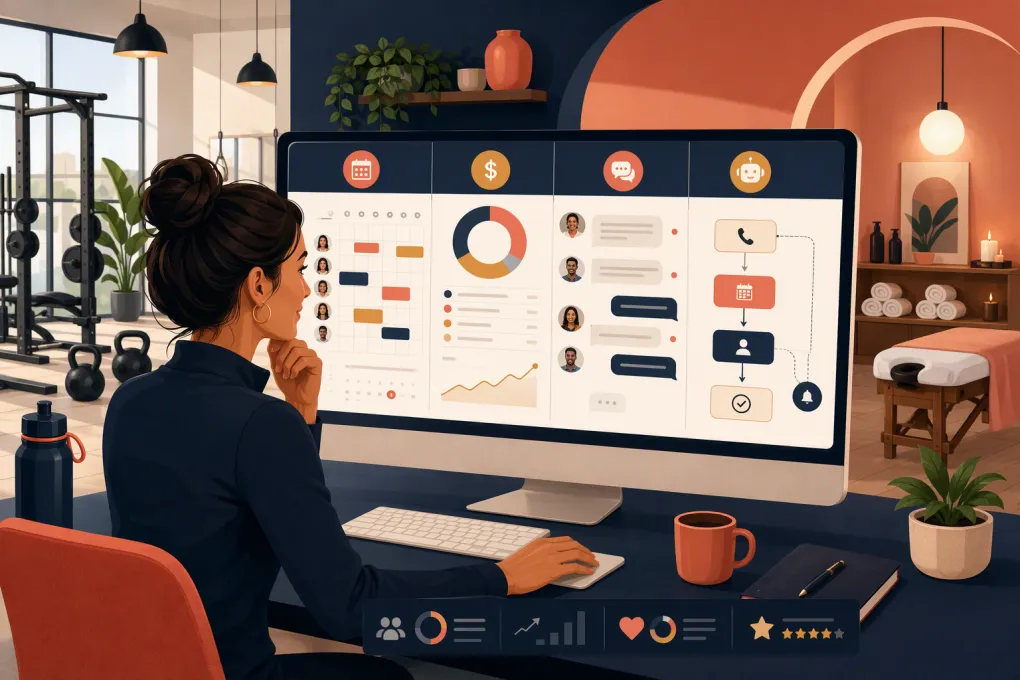


Run your gym on autopilot with WTF Go
Fitty — your AI receptionist — answers calls and DMs, fills classes, follows up with every lead, and collects dues while you coach.