Comparisons
Best GlossGenius Alternative for Med Spas: What to Pick
Looking for a GlossGenius alternative for med spas? Compare booking, payments, memberships, AI follow-up, multi-location tools, and migration risk upfront.
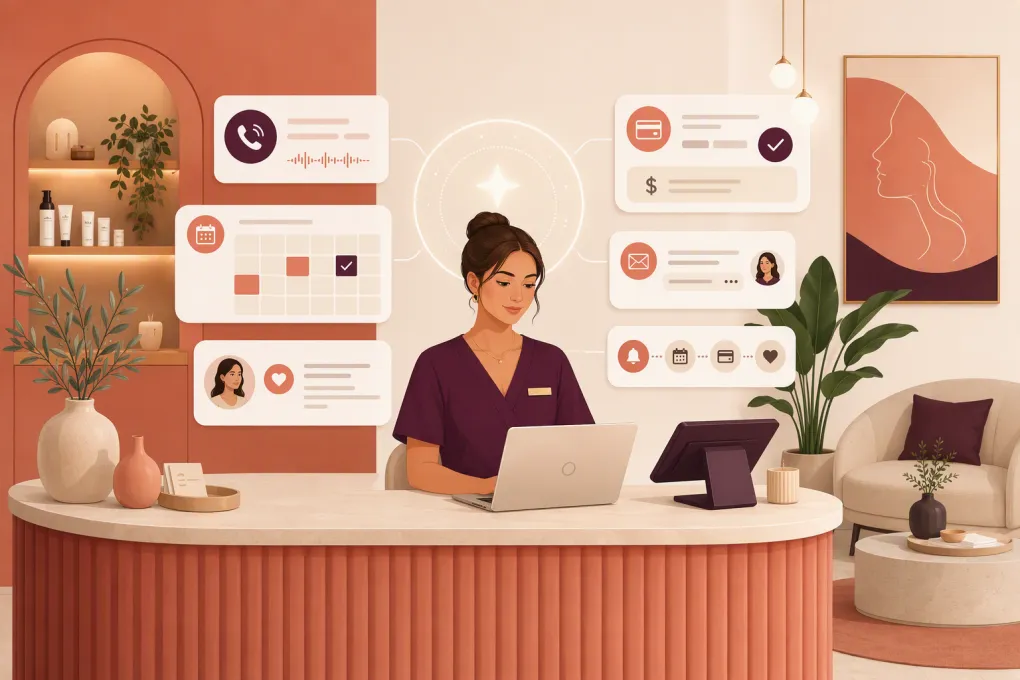 Watch · 20s
GlossGenius is a capable booking and business-management platform for independent beauty and wellness professionals. But a growing med spa often reaches a point where an attractive booking page and payment flow are not enough. Operators may need faster lead response, more persistent follow-up, membership billing, multi-location controls, clinical documentation, or an AI receptionist that can handle inquiries when the front desk is unavailable.
The right GlossGenius alternative for a med spa depends on which gap you are actually trying to close. Some platforms are built around clinical records. Others specialize in consumer booking and marketing. WTF Go focuses on operating and revenue workflows, with Fitty handling conversations, booking, follow-up, and dues collection around the clock.
Before comparing vendors, document the workflow that is currently costing you leads, staff time, or visibility. Otherwise, you risk replacing familiar software without fixing the underlying problem.
See how Fitty can respond to med spa leads and keep follow-up moving →
Why med spas outgrow general beauty software
Med spas sit between hospitality, recurring-service businesses, and healthcare. That creates operational requirements that are different from those of a solo stylist or traditional salon.
A prospective client may inquire about several treatments before deciding whether to book a consultation. The team may need to answer basic questions, explain the consultation process, collect contact information, follow up multiple times, and route clinical questions to a qualified provider. Once the client books, the business may also need deposits, intake forms, consent documents, treatment records, before-and-after photos, packages, memberships, and repeat-visit reminders.
GlossGenius may still work well for a smaller operation with straightforward appointment and payment needs. A switch becomes worth evaluating when the limitations affect revenue or create manual work across disconnected systems.
Common triggers include:
- Leads waiting until the front desk reopens
- Staff repeatedly answering the same nonclinical questions
- Weak visibility into inquiry-to-consult and consult-to-treatment conversion
- Manual membership or package follow-up
- Separate tools for phones, texting, scheduling, payments, and marketing
- Limited control across multiple locations or teams
- A need for med spa-specific clinical documentation
- Difficult reporting across providers, services, and locations
What to require from a GlossGenius alternative
Lead capture and response
A booking widget is not a complete lead-management system. Your alternative should capture inquiries from the channels you use, retain the conversation history, assign next steps, and make unbooked leads easy to identify.
Ask each vendor what happens when someone calls after hours, submits a form, or sends a message but does not book. Determine whether the platform merely sends a notification or actively continues the conversation.
Appointment and consultation workflows
Look beyond whether a platform has a calendar. Test the actual booking rules your med spa uses:
- Consultation versus treatment appointment types
- Provider, room, and equipment availability
- Deposits and cancellation policies
- Service prerequisites
- Buffer and cleanup time
- Multi-session treatment packages
- Location-specific schedules
- Rescheduling and waitlist workflows
Clinical eligibility should not be delegated to a general-purpose automation tool. Your system can explain approved policies and schedule the appropriate consultation, but licensed providers should handle diagnosis, contraindications, and treatment recommendations.
Memberships, packages, and payments
If recurring revenue matters to your model, verify how the platform handles renewals, failed payments, freezes, cancellations, credits, and package balances. Ask whether staff can see the full client relationship without checking multiple systems.
Also confirm which payment processor is required, how funds are deposited, what hardware is needed, and how transaction data can be exported. Software subscription pricing is only one part of the total cost.
Clinical records and compliance
Many booking and CRM products are not electronic medical record systems. A med spa performing medical services may need treatment charting, consent management, photo documentation, prescription workflows, and access controls appropriate to its services and jurisdiction.
Do not accept a vague claim that a platform is simply “HIPAA compliant.” Ask how protected health information is handled, whether the vendor will sign a business associate agreement when required, which subcontractors can access data, and what audit controls are available. Have qualified legal and compliance advisers review your setup.
Automation that completes work
Basic automation sends a reminder. Operational automation moves the client toward the next appropriate step.
Useful workflows include:
- Responding immediately to new inquiries
- Answering approved questions about hours, location, and booking policies
- Offering consultation times
- Following up with leads who stop responding
- Reminding clients about appointments and required forms
- Flagging conversations that need a human or clinical provider
- Following up on failed recurring payments
- Re-engaging clients who are due for an approved repeat visit
Fitty is designed for this front-office gap. It gives med spas an AI agent that can remain available outside staffed hours instead of leaving every inquiry in a voicemail box or task list.
See how WTF Go combines booking, follow-up, and payment workflows →
GlossGenius alternatives for med spas compared
No single platform is best for every med spa. The comparison below focuses on product orientation and buying considerations rather than exact pricing, which can change based on plan, location count, add-ons, and payment setup.
| Platform | Core strength | Booking and CRM | Automation or AI | Clinical capabilities | Multi-location fit | Pricing approach | Best fit and limitation |
|---|---|---|---|---|---|---|---|
| WTF Go + Fitty | Unified operations with an AI receptionist | Lead management, booking, client communication, follow-up, and revenue workflows | Fitty can answer leads, book, follow up, and assist with dues collection 24/7 | Confirm whether a separate clinical record system is needed for your services | Built for independent and multi-location gyms, studios, spas, and wellness operators | Contact WTF Go for current scope and pricing | Best for operators prioritizing speed-to-lead and front-office automation; verify clinical documentation requirements separately |
| GlossGenius | Polished client experience for beauty and wellness businesses | Online booking, client management, payments, marketing, and related business tools | Includes automated communication and marketing features, depending on plan | Not positioned primarily as a med spa EMR | Better suited to relatively straightforward operations; validate controls for a complex group | Tiered subscription model with payment processing considerations | Strong for independent providers wanting simplicity; may be less suitable for complex clinical or multi-location workflows |
| Aesthetic Record | Aesthetics-focused practice and clinical management | Scheduling, patient management, checkout, and aesthetic-practice workflows | Offers communication and practice automation features; scope varies by plan | Stronger emphasis on charting, treatment records, photos, and clinical workflows | Can support growing aesthetic practices; confirm configuration for your structure | Subscription plans and optional services may apply | Strong candidate when aesthetic clinical records are central; evaluate lead-response depth and front-desk automation |
| Boulevard | Premium client experience and operational tools for appointment businesses | Scheduling, client profiles, payments, forms, marketing, and staff workflows | Automated messaging and marketing tools are available; verify current AI functionality | Not primarily an aesthetics EMR, so clinical systems may still be required | Often considered by established and multi-location personal-care businesses | Packaging is generally based on selected plan and business needs | Strong for polished booking and front-desk operations; assess total cost and clinical-system overlap |
| Vagaro | Broad feature set across beauty, fitness, and wellness | Booking, payments, forms, memberships, marketing, and marketplace exposure | Notifications and marketing automation are available; advanced functions may be add-ons | Supports forms and business records but should not be assumed to replace a required EMR | Supports businesses with multiple providers and locations | Base subscription plus potential add-ons and processing costs | Useful for operators wanting breadth and accessible packaging; add-ons can make comparison more complex |
| Mindbody | Large wellness marketplace and broad business-management ecosystem | Booking, payments, memberships, marketing, reporting, and consumer discovery | Automated marketing and communication capabilities vary by package | Not primarily a clinical med spa record system | Commonly evaluated by larger or multi-location wellness businesses | Plan and feature packaging should be confirmed directly | Strong for marketplace visibility and broad operations; may be heavier than a smaller med spa needs |
How to choose among the alternatives
Start with the system that must serve as your source of truth.
If clinical treatment records are the central requirement, evaluate an aesthetics-focused EMR first. Then determine whether its lead management and communications are sufficient or whether it should connect with a stronger front-office platform.
If missed calls, slow replies, and inconsistent follow-up are the immediate constraints, prioritize the conversation and booking workflow. Ask vendors to demonstrate a real scenario from beginning to end: a new prospect asks about a service after hours, needs a consultation, does not answer the first follow-up, and later books.
If multi-location management is the issue, test permissions, location-level reporting, shared client records, transfers, centralized campaigns, and local scheduling rules. A platform that technically allows multiple locations may not provide the oversight an operator needs.
Use a simple scorecard with weighted categories:
- Lead response and conversion workflow
- Appointment and resource scheduling
- Clinical documentation
- Memberships, packages, and payments
- Reporting and multi-location controls
- Data access and integrations
- Security and compliance review
- Implementation effort and ongoing support
Weight each category based on your operating model. A beautiful client app should not outweigh a missing clinical requirement or a lead workflow that still depends on manual callbacks.
Plan the migration before signing
Software migration is an operating project, not just a data import. Before committing, request a written explanation of what can be transferred and what must be rebuilt.
Your migration checklist should cover:
- Client contact details and communication consent
- Appointment history and future bookings
- Notes, forms, photos, and clinical records
- Membership status, package balances, and credits
- Stored payment methods or required reauthorization
- Gift cards and outstanding liabilities
- Staff permissions and schedules
- Service menus, durations, prices, and booking rules
- Phone numbers, inboxes, forms, and website links
- Reporting access to historical data
Run both systems through several test scenarios before the cutover. Test a new lead, an existing member, a package redemption, a cancellation, a failed payment, a reschedule, and an after-hours inquiry. Keep a read-only archive when legally and operationally appropriate, and tell clients only what they need to know about changes to booking or payments.
The practical recommendation
Choose GlossGenius if its simplicity still matches your operation. Choose an aesthetics-focused platform when clinical charting is the nonnegotiable requirement. Consider broader platforms such as Boulevard, Vagaro, or Mindbody when their client experience, marketplace, or operational scope aligns with your business.
Choose WTF Go when the larger problem is that leads, bookings, follow-up, and collections are not being handled consistently. Fitty can serve as the always-available front-office layer while your team focuses on consultations, treatments, and client care.
Explore WTF Go and see whether Fitty fits your med spa workflow →
Frequently asked questions
What is the best GlossGenius alternative for a med spa?
It depends on the primary gap. WTF Go is suited to med spas prioritizing AI lead response and front-office automation, while an aesthetics-focused platform may be preferable when clinical charting is the main requirement.
Does a med spa need an EMR as well as booking software?
It may, depending on the treatments offered, applicable law, and how medical records are maintained. Confirm requirements with qualified legal and compliance advisers rather than assuming a booking platform replaces an EMR.
Can an AI receptionist answer treatment questions?
An AI receptionist can handle approved administrative information, policies, basic service descriptions, and consultation scheduling. Clinical suitability, contraindications, diagnosis, and treatment recommendations should be escalated to qualified providers.
What data should be exported before leaving GlossGenius?
Export client details, appointments, service history, memberships, package balances, gift cards, forms, consent records, staff schedules, and reports where available. Confirm separately how payment credentials and clinical records will be handled.
Keep reading

Run your gym on autopilot with WTF Go
Fitty — your AI receptionist — answers calls and DMs, fills classes, follows up with every lead, and collects dues while you coach.