Comparisons
Best fitDEGREE Alternatives for Yoga Studios Compared for 2026
Compare fitDEGREE alternatives for yoga studios across booking, payments, automation, pricing, migration, and support to find the right operational fit.
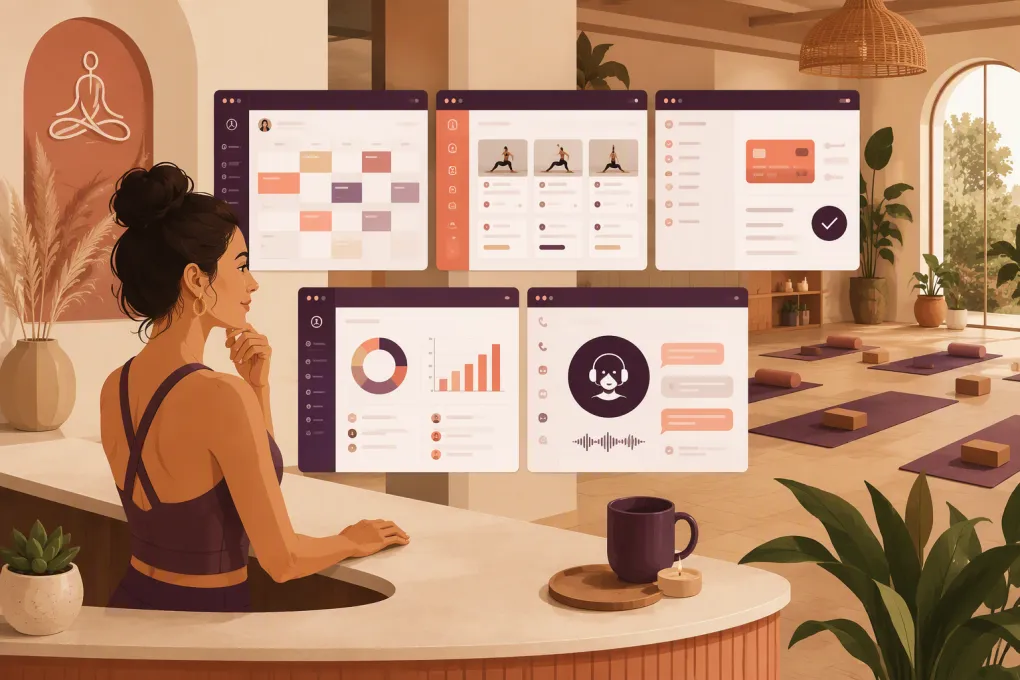 Watch · 20s
A fitDEGREE alternative should fix a defined operating problem—not merely give your studio a different booking calendar. The best choice may be a simple class-management platform, a marketplace-driven system, a spa-friendly appointment product, or an operating system with AI-assisted lead handling.
This comparison examines five credible options using publicly available product and pricing information. It is not based on a hands-on test or firsthand migration, and product packaging can change. Links to official vendor pages are included so you can verify current capabilities before signing.
Start by naming the failure you need to correct: slow lead response, difficult schedule administration, fragmented customer records, weak multi-location oversight, or too much manual billing follow-up. That decision will narrow the field faster than comparing hundreds of feature checkboxes.
See whether Fitty fits your studio’s lead-response workflow →
fitDEGREE alternatives at a glance
The table excludes fitDEGREE because the search intent is to evaluate replacements. Pricing descriptions refer to each vendor’s public purchasing model, not a guaranteed final cost. Payment processing, messaging, branded apps, onboarding, and optional modules may be billed separately.
| Platform | Verified strengths | Automation and communication | Pricing approach | Important limitation or tradeoff | Prefer it when… |
|---|---|---|---|---|---|
| WTF Go with Fitty | Combines operating workflows with an AI receptionist designed to answer leads, book classes, follow up, and assist with dues collection | Fitty can handle configured conversations and follow-up outside staffed hours; deployment depends on connected channels, business rules, and escalation design | Contact WTF Go for a proposal based on the operation and required setup | Not the best choice if you only need a basic calendar; owners must define permissions, consent rules, escalation paths, and integration requirements before automation goes live | Unanswered inquiries and repetitive front-desk follow-up are the main problems |
| Momence | Supports classes, appointments, courses, events, memberships, on-demand content, reporting, and customer-facing booking | Offers email and text marketing, automations, lead management, and customer communication within a broad studio platform | Public pricing and package information is available through its pricing page; confirm included messaging, processing, and onboarding | Breadth creates more configuration than a studio needing only passes and class reservations may want | You sell a mix of recurring classes, workshops, courses, appointments, and digital content |
| Mindbody | Mature scheduling, staff management, payments, reporting, marketing products, branded mobile options, and exposure through the Mindbody consumer marketplace | Marketing and customer-engagement capabilities are available, but packaging and optional products should be reviewed in the proposal | Typically sold through tiered business packages and a sales quote; see its fitness business software overview | Marketplace reach and broad functionality can come with more administrative complexity, optional-product decisions, and a less transparent total price | Consumer discovery, a large vendor ecosystem, or broad multi-service functionality matters most |
| WellnessLiving | Covers classes and appointments, online booking, memberships, payments, staff management, reporting, rewards, and client-facing tools | Includes marketing and client-engagement features, with capabilities varying by package and add-on | Uses packaged plans; review the current yoga studio software and pricing information directly | A large feature set requires careful implementation; verify which branded apps, marketing tools, and multi-location functions are included rather than assumed | You want a wide studio-management suite and expect operational complexity to grow |
| Punchpass | Focuses on class-based businesses with schedules, reservations, passes, memberships, waitlists, attendance, and online customer accounts | Provides member communication and class-management tools without positioning itself as a full AI sales operation | Publishes plan details on its pricing page | Less suitable when you want a broad marketplace, complex spa operations, or an AI receptionist managing lead conversations | A small or independent yoga studio values straightforward class administration and public plan visibility |
| Vagaro | Combines classes and appointments with payments, forms, memberships, inventory, payroll-related tools, and a consumer marketplace | Offers marketing, reminders, forms, and customer communication, with optional capabilities affecting total cost | Public pricing is structured around bookable calendars, with optional features; review Vagaro’s pricing page | Its service-business breadth may be unnecessary for a yoga-only schedule, and calendar-based pricing deserves attention as the team grows | Your business blends yoga with massage, beauty, recovery, or other appointment-led services |
Which fitDEGREE alternative fits which yoga studio?
Choose WTF Go when lead handling is the bottleneck
WTF Go is the most relevant option when the problem starts before a prospect becomes a member. A conventional scheduler can display classes and accept a booking, but it may not answer a caller’s questions, continue the conversation, or follow up when the prospect leaves without registering.
Fitty is designed to answer leads, book classes, follow up, and collect dues around the clock. Those capabilities should not be interpreted as unsupervised authority over every customer interaction. A responsible implementation requires the studio to define:
- Which phone, text, web, or other supported channels are connected
- Which schedules, offers, policies, and account data Fitty can access
- When the agent may complete a booking versus hand it to a person
- Which billing actions it may initiate or support
- How identity is verified before account-specific information is discussed
- How consent, opt-outs, call or message disclosures, and quiet hours are handled
- Which situations require immediate human escalation
- Who reviews transcripts, failed actions, and exceptions
Integration scope is especially important. Do not assume Fitty—or any AI agent—can write to every existing calendar, payment processor, CRM, or phone system. Ask WTF Go to demonstrate the exact workflow using your required systems and policies.
The tradeoff is straightforward: WTF Go is more than a lightweight scheduler, and setting up useful automation takes operational decisions. A studio that only needs online reservations and pass tracking may be better served by Punchpass. A studio that needs faster response and less repetitive follow-up should evaluate whether that setup work removes a larger recurring burden.
Ask WTF Go to map one real inquiry-to-booking scenario →
Choose Momence for varied programming
Momence is worth evaluating when “yoga studio” understates what you sell. Its public product materials cover classes, appointments, events, courses, memberships, and on-demand offerings. That makes it a plausible fit for studios running weekly classes alongside workshops, retreats, teacher training, private sessions, and a video library.
The advantage is breadth within one customer system. The corresponding risk is implementation sprawl. During the demo, ask the representative to configure an intro offer, a limited-capacity workshop, a multi-session course, and a private lesson. You need to see whether staff can administer those products without creating confusing customer choices.
Choose Mindbody for marketplace exposure and ecosystem breadth
Mindbody’s clearest differentiator is its established consumer marketplace combined with a broad business platform. That can matter in markets where customers already use Mindbody to search for wellness services.
It is also built for more than basic yoga scheduling, with business tools spanning booking, staff, payments, marketing, and reporting. The tradeoff is that the final setup may involve multiple packages or optional products. Request an itemized proposal and identify which workflows require an add-on.
Mindbody is preferable when discovery and ecosystem breadth justify that complexity. It is less compelling if your priority is a minimal class calendar with predictable public packaging.
Choose WellnessLiving for a broad management suite
WellnessLiving competes as an expansive fitness and wellness management platform. Its published yoga offering includes scheduling, memberships, payments, staff tools, rewards, reporting, and customer-facing features.
That breadth can support a studio adding locations or services, but it makes package verification essential. Ask for a live demonstration of consolidated reporting, cross-location member access, role permissions, branded customer tools, and marketing workflows. Then have the vendor mark each demonstrated feature as included, optional, or unavailable in your proposed package.
Choose Punchpass for simpler class operations
Punchpass is the clearest alternative in this group for owners who do not want a large software stack. It centers on the practical mechanics of a class-based business: schedules, reservations, passes, recurring memberships, attendance, and waitlists.
Its narrower scope is both the strength and limitation. It can reduce the implementation burden for a small studio, but operators seeking marketplace discovery, appointment-heavy workflows, sophisticated multi-location administration, or an AI-led sales process should look elsewhere.
Choose Vagaro for yoga plus appointment-based services
Vagaro deserves consideration when the business also operates like a spa or salon. Its product range extends beyond classes into appointments, inventory, forms, payroll-related functions, marketing, and marketplace discovery.
A hybrid yoga and wellness center may benefit from managing instructors, massage therapists, rooms, products, and forms in one environment. A yoga-only studio may find some of that breadth unnecessary. Because pricing is tied partly to the number of bookable calendars and optional features, model the cost using the actual number of instructors or resources you expect to manage.
Use scenarios instead of feature checklists
Ask every finalist to complete the same six tasks in a live demonstration:
- A new lead calls after closing and asks which beginner class to take.
- A customer buys an intro offer and books the correct eligible class.
- A full class triggers a waitlist and fills a newly opened spot.
- A member’s recurring payment fails and requires follow-up.
- An instructor calls out and the schedule, attendees, and substitute must be updated.
- A customer requests a freeze, credit, or cancellation that requires staff approval.
Record who performs each step: customer, employee, automation, or vendor support. Also record whether the action happens inside the platform or requires another tool.
For AI-assisted workflows, test incorrect and ambiguous requests—not only the happy path. Ask what happens when a lead requests medical advice, wants an unauthorized refund, gives incomplete information, or becomes upset. The correct result may be escalation, not automation.
Compare the full operating cost
Do not compare subscription prices in isolation. Request a written proposal covering:
- Base software and required plan level
- Payment processing terms
- Text, email, phone, or AI usage charges
- Branded app or website options
- Additional locations, calendars, or staff accounts
- Onboarding, data cleanup, and migration
- Training and support level
- Contract length, renewal, and cancellation terms
Then estimate the internal workload. A cheaper platform can still be the more expensive operating choice if staff must manually return every missed call, reconcile disconnected systems, or chase failed payments.
Verify migration before committing
No vendor should receive a deposit until it explains what can and cannot move from fitDEGREE. Request a sample export and have the new provider map these fields:
- Member profiles, notes, tags, and communication preferences
- Active memberships, passes, balances, and expiration dates
- Future reservations and waitlists
- Attendance and purchase history
- Signed waivers and forms
- Staff accounts and permissions
- Stored payment credentials or the process for collecting new ones
Payment credentials are particularly sensitive and may not transfer between processors. Obtain written confirmation rather than promising members a seamless move.
Run a small test import before final cutover. Check several active memberships, expired passes, account credits, future bookings, and duplicate profiles. Neither this article nor a sales demo can substitute for testing your own data.
A practical final decision rule
Choose Punchpass for focused class management, Momence for varied programming, Mindbody for marketplace reach, WellnessLiving for broad studio administration, and Vagaro for a yoga-and-spa service mix.
Choose WTF Go when inquiry response, booking follow-through, and dues outreach are the operational gaps worth solving—and when your team is prepared to define AI permissions, escalation, consent, and oversight. Before deciding, require a vendor to prove your highest-friction workflow with your policies and expected integrations. That is a stronger buying test than the longest feature list.
Frequently asked questions
What is the best fitDEGREE alternative for a small yoga studio?
Punchpass is worth considering when straightforward class scheduling and pass management are the priority. WTF Go may be a better fit when the small team also needs help answering leads and following up outside staffed hours.
Which fitDEGREE alternative works for yoga and spa services?
Vagaro is designed for both class and appointment-led service businesses, making it relevant to yoga studios that also offer massage, recovery, or beauty services. Verify room, practitioner, form, and inventory workflows in a live demo.
Can Fitty make bookings and collect dues without staff involvement?
Fitty is designed to book classes, follow up, and support dues collection, but the permitted actions depend on configuration, connected systems, identity checks, consent rules, and studio policies. Sensitive, ambiguous, or unsupported requests should have a defined human-escalation path.
Can payment information be migrated from fitDEGREE?
Not always. Payment credentials are controlled by payment processors and security requirements, so ask fitDEGREE, the destination platform, and the processors to confirm whether tokens can transfer or members must re-enter payment details.
How should I test yoga studio software before switching?
Give each vendor the same real scenarios, including an intro offer, waitlist, failed payment, instructor substitution, account freeze, and after-hours inquiry. Require a test data import and an itemized proposal before signing.
Keep reading



Run your gym on autopilot with WTF Go
Fitty — your AI receptionist — answers calls and DMs, fills classes, follows up with every lead, and collects dues while you coach.